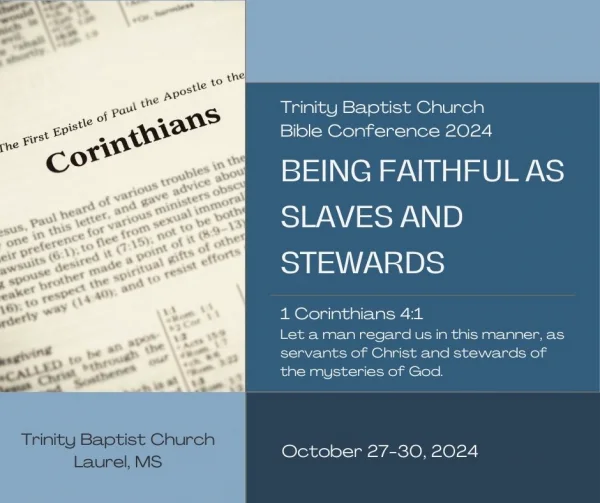
Trinity Baptist Church Bible Conference 2024 - Faithful as Slaves and Stewards
Faithful as Slaves and Stewards

1 Corinthians 4
Sermon Study
1 Corinthians 4 calls the church to faithfulness as servants of Christ and stewards of the gospel. The sermon argues that a church full of trustworthy servants is the true path to healthy, renewed church life.
Primary Scripture
- 1 Corinthians 4
Mentioned Scripture
- Acts 18
- Luke 16
- Acts 20
- Acts 2
Transcript
Thank you, Miss Marilyn. You know, I've been serving in the life of the church to know one thing, probably only one thing, and that is sound systems and things like that, I think they're made to give you problems in their rights. So it shows us that we have to be patient, wait on those things to work themselves out. I want to mention something that Brother Neal mentioned. He mentioned the fact that this is a Bible conference. I've thought about it several times. I don't know that I've preached a Bible conference. I've preached revivals. I've preached youth camps. I've preached hayrides, pumpkin patches, a lot of other stuff.
You know, when it really comes down to it, no matter if it's called a revival or a Bible conference or renewal services, if God's Word is taught and the Spirit of God works and we receive it, that's what matters. You know, it's sad. We live in a day and a time where the word revival has been abused a lot. And in the life of our church, when we have services like this, I'll call it revival and renewal. We're looking for the Word of God, the taught Word of God, to be preached and the Spirit of God would use it to revive us and renew us.
So whether this is a Bible conference or whatever, if the Word's taught and we're revived and renewed, that's what matters. That's what matters. So if you would, take your Bible, turn to 1 Corinthians 4, verses 1 to 5. 1 Corinthians 4, verses 1 to 5. Well I hope that you've had a good day. I hope that these messages, these series of worship services have been good for you. It's been very, very good for me. And again, I thank you for allowing me to be here. I thank you for the privilege of pastoring you these days and coming alongside Brother Bill and under Brother Bill and pastoring you. It's simple.
I'm here to make you a better believer and I'm here to help make you a better church. I'm here to minister to your pastor and to help your pastor be a better pastor and your pastor is helping me be a better pastor and you are helping me be a better pastor. And I'll take that back to our church and pray that God will use that in our church, at Grace Life Church, Brookhaven. Here a while back I was asked to go to a particular church, a friend of mine's church, one of my mentors, and I was invited to be on a guest, one of several guests on a podcast and spent the weekend with them and I came back really revived.
And after I had preached that Sunday, one of the men said, "You know, if you come back, live like that and preach like that, we'll send you all about once a quarter." So I hope that when I go back and I preach Sunday that the men, people of our church will say, "You've come back revived." That's one of my goals. Now I know that this week is all about being slaves and stewards. That's the theme of the conference. And that is where we finally find ourselves tonight. And I want us to remember, and I'll say this over and over, all of these messages go together. So I pray that you will receive these messages that way.
I challenge you that you would study these messages this way. And I was sharing with one of the precious ladies that if they needed my notes, they could get them. Now, often in the life of our church, I'll say, "Take notes, take notes." But I know we all learn different. And I would rather you put your pen down and really absorb it in your mind and in your heart while I'm preaching and teaching than get distracted. So I can have my secretary send the notes over to you. And if that helps you, then that would be a blessing. But I will say this, don't judge me by what they sound like. They're preaching notes. They're not a paper by no means.
But I want to challenge you to do something. Last night I challenged you to share with Brother Bill if the messages have been speaking to you. But I want to challenge you that if God is working in you and God is speaking to you and correcting you and changing you, reach out to some of the other brothers and sisters in the life of the church and share what God's doing in your life. Share if he's correcting you or encouraging you or teaching you or all of the above. And I'll tell you, if you do that, you'll edify one another, you'll encourage one another, you may even correct one another. God will just use that to build up the body.
I know he does that in my life. Now let's get to our message. Now before us in our verses, we have 1 Corinthians 4 verses 1 to 5 before us. We need to understand the basic background of this letter. And then we need to know what's going on behind these particular verses. And finally, why in the world Paul wrote these verses? I think we all know that this letter was written by the Apostle Paul to a church. That was the church at Corinth located in the city of Corinth. And if we know our Bibles, we know that Paul wrote two letters to the church at Corinth. But in Ponce Day, the city of Corinth was an interesting city and a very dangerous city.
Corinth was a large and economically prosperous city. That is because there was a major north-south trade route that ran through the city. The city prospered as a major trade city, and this brought great prosperity, and it also brought great diversity. Not only did the city prosper, but most of Greece prospered in most of the area of the Mediterranean prosper. So that meant that Corinth was a wealthy, multicultural city, which led to Corinth being a very sinful, a very wicked city.
Even by the very pagan standards of their day, Corinth was so morally corrupt that the name Corinth came to symbolize nothing but moral corruption and all kinds of sin and sinfulness. In their day, two Corinthian eyes spoke of and represented all kinds of gross immorality and drunken sinfulness. So Corinth was a dangerous city because of the great sin and sinfulness there. But God had a plan. God had a plan. In Acts 18, we see that while he was on his second missionary journey, Paul went to Corinth. And as was his custom, Paul started his ministry in Corinth by going to the Jewish synagogue.
But after resistance from the Jews, he took the gospel to the Gentiles. And as a result, the ruler of the synagogue believed, along with his whole household. So right there, the church of Corinth was born. And if you read of these things in Acts 18, you will see that Paul ministered in Corinth for a year and a half in peace and safety with much success. I know I mentioned that last night. But the Corinthian church had a tremendous struggle. Now if you read 1 Corinthians and 2 Corinthians, you will see that there were many, many sins and struggles that plagued them.
But their biggest struggle came from the fact that they were not able to fully break away from the corruption of the Corinthian culture. So that meant that the church was plagued with all sorts of sin that came out of, as a result of, the world around them. They followed, or excuse me, they allowed gross sexual immorality in their church. They allowed drunkenness in their church. They allowed pagan views concerning marriage in their church. That's just the name of you. So that led Paul to write two letters. And his goal was to straighten things out. His goal was to straighten those things out and to bring the church to biblical health.
But we need to see what I call the background of the particular verses that we have before us. We need to see what was going on here that made Paul write as he wrote in chapter 4. One of the big problems in the Corinthian church was how they viewed church leaders and pastors and how they evaluated them. Now if we go back to chapter 1, we see that Paul addressed how they were terribly divided over which leader was the best. Some of them said that they followed Paul. But some in the church said they followed Apollos. But some in the church said they followed Peter. But I call this the super spiritual group.
There were some, they said they followed Christ. Simply they had elevated certain leaders at the expense of others. Even the ones named there were all godly men and they were all God-sent men. Yes they should have followed Christ. That's obvious. But if they were to have followed Christ properly, they would not have divided because of an unhealthy allegiance to the men that Christ had sent them. But here in chapter 4, we see that Paul addressed another problem that was related to how they saw and related to their leaders.
Not only did they divide over God-sent leaders, but they evaluated and judged those leaders in a very unhealthy and even sinful way. As a matter of fact, some in the Corinthian church even had a wrong view of the Apostle Paul. Some even questioned Paul's apostolic call in ministry. For one, they saw his suffering as inappropriate for a true Apostle. And chapter 9 tells us that they saw Paul's unwillingness to take financial support and to take a wife as the other apostles did. They saw those things as inappropriate for an Apostle as well.
So here in chapter 4, Paul explained to them how they should have viewed him and the other God-called men that ministered among them. And he explained the character and the characteristics of a God-called minister. He explained the requirement of the God-called minister. And he explained who determined these things and who evaluated these things. And for us, we will see how Paul, how this applied to Paul. We will see how this applied to others like Apollos, how this applies to the leaders in this church, how it even applies to me. But we'll see how this applies to all of us in the pew at Trinity Baptist Church and in our church as well.
So let's finally get to our verses. First Corinthians chapter 4, verses 1 to 5. This is how one should regard us or consider us as servants of Christ and stewards of the mysteries of God. Moreover, it is required of stewards that they be found faithful. But with me, it is a very small thing that I should be judged by you or by any human court. In fact, I do not even judge myself, for I am not aware of anything against myself, but I am not thereby acquitted. It is the Lord who judges me.
Therefore, do not pronounce judgment before the time, before the Lord comes, who will bring to light the things now hidden in darkness and will disclose the purposes of the heart. Then each one will receive his commendation or praise from God. Now out of these verses, we will look at the character and characteristics of the God-called men. I've already mentioned that. We'll look at the requirement of the God-called man and who determines these things. I've already mentioned that. And we will see that there are rewards for these things. And then we'll make some application. I'll make quite a bit of application really all along the way.
So number one, notice Paul considered himself a slave. Number one, Paul considered himself a slave. Now I want us to look closely at the first part of verse one. And notice how the different translations approach the language here. The King James says, "Let a man sow a count of us as of the ministers of Christ." The new King James says, "Let a man sow consider us as servants of Christ." Now I'm reading from the English Standard Version. And notice what it says. This is how one should regard us as servants of Christ. Now notice, the King James uses the word ministers. The English Standard, the new King James, uses the word servants.
But I want us to see that neither of those words really get at what Paul is saying here. Now in the original, Paul used a particular word. Now I've already told you how I feel about pronouncing Greek words. Maybe when a fellow from South Mississippi tries to pronounce a Greek word, he sounds like a fellow from South Mississippi trying to pronounce a Greek word. But Paul used the word that's called or pronounced "hooperaetes." Hooperaetes. In this word, spoke of something and someone a lot lower than a servant and a lot lower than a minister.
This word literally meant "under rower." Because originally a hooperaetes was the lowest of slaves who rode on the bottom section of a Roman galley ship. There were, they were literally the lowest, the most despised slaves. When they were at their oars, historians tell us that they were chained to their seats and bare feet. And some historians even mention that they barely had enough clothes to clothe themselves. It was common that they ate stale or molded bread and some type of cheap bean stew. And they were forced, excuse me, and they were forced to eat and to sleep and to work in their own filthiness.
And if they could not perform their duties at the oars, they were simply thrown overboard. And some historians say that they would have been killed and thrown overboard. And from the use of that term in their day, a hooperaetes came to speak of and represent the lowest of subordinates of any kind who were under authority. Now without in mind here, without explanation in our minds, notice what Paul was saying and doing. He was calling the Corinthians to consider him a hooperaetes. He was calling the Corinthian believers to see him as a hooperaetes. The lowest of slaves.
And that is because Paul, he considered himself to be a hooperaetes, the lowest of slaves. So Paul considered himself to be this hooperaetes and he called the Corinthians to consider him and those other God sent men as hooperaetes. And if we study the life of Paul, we will see that first and foremost, he was a hooperaetes of Christ and a hooperaetes of the church. Now I'm not going to call you to turn there, but if you turn over to 1 Corinthians chapter 9 specifically verses 11 to 15, you'll see one of the issues that the Corinthians had with Paul. And this is what was going on there.
Paul refused to receive financial support from the Corinthians. That's one of the reasons that they looked down on him as an apostle. But he says over in chapter 9 that he refused financial support because he did not want anything to be a hindrance to the gospel. What that word hindrance means in the original, it literally means a cut ditch in a road. And what he knew was this. If he demanded financial support, which he deserved, he knew that that would hinder the work of the gospel in their life. So he was a hooperaetes and he said, no, you keep your money.
That way there will be no obstacle, no hindrance to me preaching the gospel in your life. You see? But then next, number two, Paul considered himself a steward. Paul considered himself a steward. Look back at verse one, really the second part of the verse. The King James says, let a man so account of us as the ministers of Christ and stewards of the mysteries of God. The English standard version says, this is how one should regard us as service of Christ and stewards of the mysteries of God. Now here we see that not only did Paul want to be considered a hooperaetes, but he also wanted to be considered a steward.
Now in the original language of the word for steward here, it simply meant a manager or a superintendent, a steward. And in their day and culture, it was very common for a wealthy man, a rich man to have a household manager or a household steward. This was common in their day and they were servants and they were even sometimes a slave and they managed the rich man's entire state. The steward or manager would oversee their master's property and any of their fields, any of their animals, their vineyards, even their master's finances and other servants and slaves as well.
As a matter of fact, in Luke 16, we see the parable of the dishonest manager or the dishonest steward. In the parable, the rich man had a manager or a steward. Now let me pause there. When our Lord taught that parable, that was common. Those listening understood, they understood a wealthy man having a steward. But here in the parable, we see that the manager of the steward, he was held accountable for mismanaging his master's possessions, his master's estate. But notice in the verse, Paul said he wanted to be regarded as or seen as a "huperetas," steward or managers of the mysteries of God.
And that is because he knew that he was a steward and a manager of the mysteries of God. Now, question. What are the mysteries of God? I mean, how do we find out what the mysteries of God were and are? Do we turn on TBN to see what they have to say? It is simple. The mysteries of God is a reference to what the Old Testament foretold. Simply the Old Testament is full of promises, types, and shadows that speak to what was to come in the New Testament.
The Old Testament is full of promises, types, and shadows that speak of the coming of the Messiah, the gospel of the good news that salvation was and is provided for mankind through God's promised Messiah. The Old Testament is full of promises, types, and shadows that speak of God's salvation for both Jew and Gentile. Simply the Old Testament speaks of the coming of the church and the church age. These things were the mysteries of God to those Old Testament saints, but the mysteries were revealed to and revealed in and through those New Testament saints. So what Paul was saying here is this.
As a chosen apostle, he saw himself, he understood himself as a manager or a steward of the Old Testament mysteries revealed. He saw himself as a manager of the gospel, salvation for men and men found in the person of Jesus as God's promised Messiah. He saw himself as a manager of the birth and the growth and the development and the health of the church. And of course, there were other men who were apostolic stewards as well. Peter was. And then there were others along with the apostles that were not apostles and they were stewards of well. We talked about one young pastor Timothy. He was not an apostle, but definitely a steward.
So Paul considered himself. He knew that he was a steward and a manager and he called the Corinthian believers, that church to see himself as a steward as well. And if we study the life of Paul, we will see that simply he was a steward or a manager of the gospel, the message of the gospel, and he was a steward or a manager of the church and the health and the progress of the church. Let me pause here. Do you realize that the apostle Paul was a one trick pony? He went from city to city, town to town, preached the gospel. Any who were evangelized, he formed them into a church. Then he went to another town and did the same thing.
And then he came back around ministering to those churches for Paul. It was all about the church. One trick pony. So let's take a step back here and let's see what Paul was in his saying in verse one. He was explaining to the Corinthians the true character and characteristics of a true minister of God in opposition to how they viewed and evaluated ministers and leaders. Paul was calling them to see him and those other God called God sent men. He was calling them to consider them as slaves who parade a slaves and as stewards of the revealed mysteries of God. Now right here, there may be one saying, well, that's nice pastor, but that's Paul.
That doesn't have anything to do with us. We do not live in that day and we are not apostles. Anybody remember the old gong show? I'm showing my age. You know when those contestants got an answer wrong, he hit a big gong. Wrong answer. Well, if you think this doesn't apply to us, somebody needs to hit the gong. Wrong answer. Look over to verse 16 chapter four. Real simple. What does he say? He's writing to the Corinthians now. I urge you then be imitators of me. You see, so let's start at the top or at the bottom. Let's work our way down or work our way up.
That means brother bill, he must consider himself as a who parade taste, which means that brother bill must consider himself to be at the bottom. The very lowest of slaves of Christ and the very lowest of slaves for the church bill. That is what our Lord expects of me and you, you and me. That means if we got to take out the trash, we take it out. I think it's appropriate for us sometimes as ministers to hold the standard high, but then to also explain that we're sinners too. The other night after a pretty large event in the life of our church, my wife and I were cleaning. Everybody else went home. They were tired. They'd been serving.
My wife was sweeping, mopping, picking up, taking out the trash. She was being a very good who parade taste. It was about nine 30 or a quarter to 10. I was tired. My feet were hurting and I looked at her about three or four times. I said, I don't care. I want to go home. I wasn't a good who parade taste. She was. That means that we've got to serve a VBS if we need to. I serve a VBS. I went to our VBS director this past year and I said, what do you want me to do? I used to teach some, I used to help with music song. She said, will you help take out the trash? I said, I will.
Well that led to ridicule because me walking around, all the other people looked at me and said, there's the pastor doing nothing. I said, I'm doing what I'm talking. That means if the teenagers need to be taught, you teach. See there's a thousand and one things that need to be done in the life of the church. Who parade taste serves. Whatever needs to be done now. A couple of probing questions here. Does a who parade taste get to set the terms of their life, their time, their possessions? No. Does a who parade taste get to make any decisions outside of the wheel of his master?
No, but church, the number one job of the pastor teacher here who is a who parade taste is the preach the word and the rest of the new Testament tells us that the job of the pastor teacher, who is a who parade taste, he is to govern the church. First Timothy five 17 and he is the shepherd, the flock of God. That is first Peter five one to three. You can boil brother bills, job description down to three things. He is to shepherd the flock. He has to teach and preach and he is the governed governed teach shepherd all while being a who parade taste. That's my job too. But I want to give you a warning here. I'm speaking to all the leadership.
I hope and pray this sitting in the life of this church. Do not use this as a way to keep your pastor humble. You ever seen that? I've seen it. I've heard it. I've heard people stay like this. You know, you can't pay your pastor. Well, you know, you can't give him too much. You just got to keep him home. You know, pastors got to be humble. Got to be me. We sang about being a servant, being humble and me. If we pray about being, if we sing about and pray about being a servant, the Lord might make us one humbling me.
But there are some people they think it's their job to keep the pastor humble and keep the pastor meek and to keep the pastor chained. But I say otherwise, not me, God's word. First Timothy five 17 says, let the elders who rule well, brother bill is a pastor, shepherd, elder overseer. One of those terms in the new Testament are synonymous with one office. Okay. First Peter five 17 says, let the elders who rule well be considered worthy of double honor, especially those who labor in preaching and teaching. See double honor makes people nervous.
Let's just say what the Bible says and double honor does not mean you let him go through the food line at the fellowship so he can get a piece of white meat chicken before it's gone, but you keep his payload and being in double honor does not mean you pay him well. And then you expect him to be the little preacher boy for hire and he just at your beck and call. That's not what that means. Look church, look leaders. God never blesses greediness. He never blesses greediness, but he always blesses generosity and God never blesses a church who mistreats their pastor.
I share with y'all that I took a church that was almost closed and there was a time I made a hundred dollars a week. I was glad to get it. But after the Lord shipped things out, it became evident that there were people in charge who were greedy. And while I was making a hundred dollars a week, barely getting by and I was a whoop of right takes now I cut the church grass. I did whatever needed to be done willingly. I love doing it. They were siphoning money off ties and offerings and putting it in the cemetery account. See greediness. Oh, but then I had another group come along. They were real spiritual.
They would bless you at certain times, but they never really cared what you made. They never really cared about how much you work. Oh, but they would scrutinize your doctrine. They'd scrutinize how you live. They would question you about every little nitpicky thing. But my experience isn't like that now. God's blessed us in the life of our church. I'm going to be honest with you. We're in financial meetings. There are certain men who want to pay me more and I have to say we can't do that. We have to have balance. I've got men who worry about my vacation because they worry about my health. I've got men who love me.
I've got men who support me and care for me and they honor me because they know that a healthy pastor means a healthy church. You cannot separate the two folks right now. Brother Bill's nervous. This is either truth or it's not. See folks, there's the doctrine of balance. You can preach on being a hoop or a taste, but people will abuse it and all you can do is preach on double honoring. People will abuse that. It's called balance. Well this goes beyond the pastor teacher. This applies to all of us. All of us. What is verse 16 say? But you then be imitators of me deacons any person in leadership. This applies to you.
All says to you that you are to follow this example by being a hooper rate taste. Now right here I will show you three tests to see of the leaders in the life of the church. Any deacons committee committee members committee heads. All leaders are truly hooper rate taste slaves. First test when it's time for what I call hands on deck ministry. What do you do? Does your pastor ever step up here and say, all right folks, all hands on deck. I do that. There are times I'll say folks we got vacation Bible school. Everybody's got to serve. Do you scatter like a cove of quail when your pastor does that? You're not being a hooper rate taste.
Second test when it's time to serve and do things that require after hours service and doing those jobs that no one wants to do. Now I don't know a lot about your church, but I'm telling you there are jobs around here that nobody wants to do. Do you run from those jobs or run to those jobs? See that's a test if you're really a hooper rate taste because every job in the life of the church is important. Third test when your pastor who is the pastor teacher who rules and governs well when he is preaching and teaching God's word and he calls the church to change how the church is structured and how the church functions based on God's words.
What do you do? Do you resist or run to it? It's a test of a hooper rate taste. Does the hooper rate taste get the unchain himself and climb through the galleys and go to the top and tell the captain of the ship what to do? He's changed. Now question, what about a test for the pastor? I've talked about tests for you. What about a test for the pastor and me? What about us? My job, Brother Bill's job is threefold. The pastor is to govern the church, to labor in preaching and teaching the word of God, first Timothy 5, 17, and to shepherd the flock of God, first Peter 5, 1 to 3.
And if Brother Bill is not doing these things well, I did not say great. Well if Brother Bill is doing these things well, if he's doing these three things well like we see here with Paul, he's being a hooper rate taste. Look church leaders in evaluating your pastor, ask these three questions. First is Brother Bill preaching and teaching the word? Is he working hard at preaching and teaching the word? Does he have the attitude in the heart and the demeanor as he preaches God's word? Does he have the attitude in the heart of the demeanor of a hooper rate taste? Second is Brother Bill governing the church according to the word of God?
Governing, leading, ruling the church according to the word of God, not like a tyrant, not like a mob boss, but as a loving kind hooper rate taste. But is Brother Bill shepherding, pastoring the flock according to the word of God as a slave, a hooper rate taste? If he's doing those three things well, folks, you know what you got? You got to keep her. Notice I don't say great. And look, if he's doing those three things well, he's a busy man. If he does those three things well as a hooper rate taste, he is busy and you're going to have to come to him and say, "Are you taking your day off like you should?
Are you taking your vacation like you should? You see?" But notice that I've not said much about being a steward and a manager. I don't have time to get to Luke 16, 1 to 11, the parable. Now there's much in this parable, you can go read it, but there's 1.1 lesson in the parable. The basic point of the parable is the management or the mismanagement of the steward. The steward was responsible for the rich man's possessions and he had to give an account. That's the basic point of the parable.
But in borrowing what we see in this parable, I'll say this, Jesus is the rich man, the church is his possession and we have been given his church, but we do not own it, it's his. And we are simply managers and stewards and we will give an account. I've got written in my notes here repeat, we've given an account. It's his. And Luke, church, brother Bill first, and then the other leaders, and then the body of Trinity Baptist, we will give an account for how you manage and what's been entrusted to you. The living Lord Jesus purchased the church with his own blood and has handed it to you.
We are responsible for the gospel, the message of the gospel in the work of the church and the health of the church and the progress and the growth of the church. Good night above. Look at the seriousness of this stewardship. We are managing that which Christ purchased with his own blood. In Acts 20, Acts 2, 28, Paul is warning the elders of the church at Ephesus. And what does he say? He's right. He's talking to the elders now. He says, pay careful attention to yourselves into the flock. That's the body in which the Holy Spirit has made you overseers.
See there's that word overseers again to care for the church of God, which he obtained with his own blood. Look folks, this is not ours. He died on the cross for the church. It doesn't get any more serious than that. We are responsible for something extremely serious. Then number three, Paul revealed the requirement of the slave and the steward. The requirement of the slave and the steward. This comes from verse two, the King James says, moreover, it is required in stewards that a man be found faithful.
Now the English standard reads the same, but notice the new American standard says in this case, moreover, it is required of stewards that one be found trustworthy. Now, I want you to notice two things here. First, the requirement is not optional. Notice it is required. This is expected. This is not optional. This is a requirement. This is a demand. The verse reads, moreover, it is required in stewards that a man be found faithful. And if it's required, it's required. Second, what this requirement is. Now I pointed out that the King James and the other translations use the word faithful, but the new American uses the word trustworthy.
Now why? Because this word in the original, it can simply mean either or both. This simply speaks of being faithful and trustworthy. This speaks of being trustworthy and faithful. Let me give you an example. This is easy for us to see. An employee who is faithful to handle the boss's business and money is trustworthy. They are trustworthy. Why? Because they're faithful. So Paul was saying that he was and wanted to be considered a slave, a hoop of righte, and a steward. And he was explaining to the Corinthian Christians that God required that his slaves and his stewards be trustworthy and faithful, faithful and trustworthy. Now a question.
What was Paul? Was Paul faithful and trustworthy? Was Paul trustworthy and faithful as a slave and a steward? Oh yeah. Doesn't get any more faithful than that. Now I know I made lots of application when we saw that all should possess and exhibit the character and characteristics of hoop of righte slaves and stewards and managers. But here the application is simple and straightforward. In all our responsibilities with being hoop of righte slaves and stewards and managers of the gospel and his church, simply we must be found faithful and trustworthy, trustworthy and faithful.
And look, Trinity, do not expect God to do great things for you and in your church, his church, unless you are faithful and trustworthy with what you have now. I mentioned the word revival. I'm not against the word. It's just been abused so bad it's hard to use it. Now think about what I'm going to say. Most churches want revival, but they really want God to just come simply help them do what they've already been doing better. They're not willing to change. But look church, we don't need that kind of revival. Now if we're doing something right, that's okay. We need God to help us do that better, right?
But we don't need that other kind of revival. We need a revival where we see what God's word says we should be, where we see what God's word says we should do. And then because we are a Holy Spirit field and Holy Spirit empowered, we change and we repent where we need to so as to be what God wants us to be so as to do what God wants us to do. And if you do that, you'll have a revival. But before I move on, Brother Bill, are you being faithful? Are you going to be faithful? See, faithful? For how long? To the end. Remember I talked about those guys that quit? Now my parents were school teachers. I can't say this in my miles around.
Bill, can't have no quiddance. Can't have no quiddance. You see, the question is, does God see us, you, as trustworthy? Therefore He can and will give us more and He can and work through us more. Now church, if you notice that I've been picking on Brother Bill a little bit in my application, sometimes quite a lot. Now why am I doing that? Is it because I know he's in some kind of secret sin? No. Because he's my friend? No. I'm making a lot of application to him and for him for a reason. And I'm going to enter that tomorrow night. But that is for a reason.
But in all these things, we must start and we must end with the pastor and the teacher because God has appointed the pastor as the pastor of the church. Then we go down to the other leaders and so on. But one more thing here. Faithfulness to the end. A trustworthiness to the end. Look folks, we cannot have quiddness. But another thing we can't have in us is this. Disqualification. How many Christians sin and blow it and disqualify themselves? How many pastors and teachers sin and disqualify themselves? We can't have that in us. Then number four, Paul revealed who determines the success of the slave steward.
We see this in verses three to four. We'll read them here in just a minute. Now there is more. Now this is more important than you may know. That is because so many in the church here judged success by very worldly and humanistic ways. And that goes on today. Even good pastors and other church leaders can do this. And this is something that we need more than we know. Let's look at verses three to four. Chapter four. But with me, it is a very small thing that I should be judged by you or by any human court. In fact, I do not even judge myself for I am not aware of anything against myself, but I am not thereby acquitted.
It is the Lord who judges me. Now I want you to see that Paul deals with three people here. That's the examination of the Corinthians in verse three. Here Paul is speaking of the problem he was addressing. Those in the Corinthian church were examining Paul and his companions and they were making a determination if they were of God or not. Some of the Corinthian church questioned Paul's apostolic ministry and called. They saw his suffering as inappropriate for an apostle. And in chapter nine, those verses tell us that they saw Paul's unwillingness to take financial support and to take a wife as the other apostles did.
They saw that as inappropriate for an apostle. So some were examining Paul and his associates and they were making the wrong determination about them. But Paul says here that he is not to be judged by them. Now question. Are you the kind that sit back and examine the pastor and make determinations about him? Let me explain. In the life of our church a few years back, we had a group of people that loved to stand out up under the magnolia tree. Now let me explain what I mean. Out in front of our church there was a magnolia tree. And there was a group of people that loved to congregate at certain times under that magnolia tree.
But you know when I walked up they got quiet. They got real sheepish. Acted kind of funny, changed the subject. But see in time what we found out was they were examining and making determinations and judgments. And they loved to do it in secret and in private. And every now and then that kind of stuff would come out. Now ultimately God revealed it. But are you that kind of person? You sit back in the corner. You whisper to others. You're examining and making determinations about your pastor. Well if you're doing that that's wrong. If your pastor is in sin there is recourse to deal with it. He's not the pope. Untouchable.
First Timothy 5.19 deals with church discipline with a pastor. You go to one or two other elders in the life of the church. You go to one or two other deacons and you say, "You know I'm seeing this with Brother Beale and they will determine if it's valid or not." But what am I trying to show you? I'll be like the Corinthians and examine and make determinations out of the wrong spirit with the wrong motives. And then second, self-examination. We see self-examination in the beginning of verse 4. Oh this is good. Look at verse 4.
"For I am not aware of anything against myself." Here Paul was saying that in the matter of service as a huparates of Christ and of the church he was not conscious of any charge of unfaithfulness, not that he saw himself in his service to Christ and the church's perfect no. So Paul was not into self-examination. He was not aware of any unfaithfulness because he was a faithful trustworthy servant. Now there's a lesson here and this is strictly for Brother Beale. Brother Beale on guard against the pit and of the sin of spiritual and vocational introspection. We talked about that today. Let me show you what you do here.
First if God's word doesn't tell you that you're in sin or I'm in sin. Second if the Holy Spirit does not show you that you're in sin and I'm in sin. Third if trusted leaders do not say that you're in sin or I'm in sin. Fourth if trusted other brothers do not say that you're in sin or I'm in sin. Well they say that you're not in sin. You see? Be on guard against introspection that will devour you. But look Beale if you allow yourself to get like this you'll become like Barney Fife. Anybody watch Andy Griffith?
If you know much about Barney and the right circumstances he'd get all worked up and excited and trip and fall and shoot through the floor and all that good stuff right? Andy would instigate him and get him that way right? But seriously Brother Beale when Barney Fife got all worked up he was a nut. But if you get yourself into that pit of self spiritual and vocational introspection you'll be a nut and you can't pastor that way. Third the examination of God. Look at verse 4 again. For I am not aware of anything against myself but I am not hereby acquitted it is the Lord who judges me.
Now this is simple Paul was saying look Corinthians your examination and determinations are faulty and wrong and I'm not falling for the trap of self examination. I am not aware of anything wrong in my stewardship as a huparates of Christ and of the church but it is God who examines me, God who determines and God who judges. So Paul trusted in and looked to God's examination and judgment. Now there's a question here. How can we have God examine us as individuals and as a church and reveal to us his determinations about us being huparates slaves for Christ in his church and for his church. Faithful stewards.
How can we find out how we're doing there? It's real simple folks. Compare ourselves to what God's word says. I've been saying it all week. It's like the Bible goes together. All we got to do is read it, figure out what it says and copy what it says. So that means that Trinity Baptist Church, Christ's life church, we desperately need a pastor teacher and others as well to faithfully preach God's words so we can see who we are. Notice how it all goes together. So Paul revealed who determines the faithfulness and trustworthiness of Christ's huparates slaves and stewards. Now before I move on I want to warn you of a trap and error.
I call this the trap for settling for the status quo. You know what status quo means? It simply means the state of being the way things are. So many churches, so many pastors, so many leaders, they just want the church to stay the way it is. And the revival they want is God coming to help them just do the status quo a little bit better with a little more excitement. Isn't that right? And look church, we must, we must be willing to let God examine us, make His determinations and judgments from His word and then we must change according to God's word. And look, that church is being a faithful and trustworthy huparates slave and steward.
That's it. And then number five, and this will be rather short, Paul revealed the reward of the slave and the steward, the reward of the slave and steward. Look at verse five, "Therefore do not pronounce judgment before the Lord comes who will bring to light the things now hidden in darkness and will disclose the purposes of the heart. Then each one will receive his commendation or praise from God." Now we don't have much time and there's a lot more that I can say here, but I want to give us the gist of what we have here. What we have here is this.
Paul was warning these Corinthians to be very careful in making their determinations in these things. He was calling them to judge nothing before the appropriate time. He was calling them to wait until the Lord comes. He was calling them to wait until the Lord comes because He is able, He was and is able to examine and determine and judge not what is seen, but also what is seen. Not only what is seen, but also what is seen. He is able to examine and determine and judge not only what is done, but also the motives behind what is done. You see?
And Paul goes on to say that when the Lord comes, He will reveal the purposes of the heart and to each one all, they will receive their commendation. The King James says praise. This simply means praise, commendation or honor. Now what's the point here? Paul was saying that the appropriate praise, honor, reward and commendation will be given by the Lord to those who were faithful and trustworthy, who partake slaves and stewards, but we must see that the praise, honor, reward and commendation is only for the faithful and trustworthy. The trustworthy and the faithful. You notice the reward is not for the flashy and the super talented.
How many come along that are flashy and super talented and then they fizzle out? Their flash fails. Notice He didn't say this is for the spectacular and the sensational. They come along and they're sensational to the, I guess the sensation wanes. The honor, the praise, the reward, the commendation is for the faithful and trustworthy and look church, look brother Bill, let's simply be faithful and trustworthy and let God take care of the rewards because He knows what He's doing. Now I want to close by showing us how this all fits together.
Look church, if we are faithful as who partake slaves and stewards, if we are faithful to preach the word, if we are faithful to small group ministry, if we are faithful to the filling and the empowerment of the Holy Spirit, look folks, your church, our church will simply have a New Testament church on our hands. See and I want to close by getting political one more time. Look church, the election's coming up. Let's just commit that to the Lord. If God wants to make America greater again or if He wants to allow us to continue down the same path or maybe even worse, so be it. He's in control.
Let's trust God with that and move on to more important things. So let's make the church great again by having a church full of believers who are faithful and trustworthy, who partake slaves and stewards of the gospel and His church. So the title of the message is Faithful as Slaves and Stewards. Now before I pray, I want to challenge you. Don't miss tomorrow night. Don't miss tomorrow night because it gets even better. Let's pray.