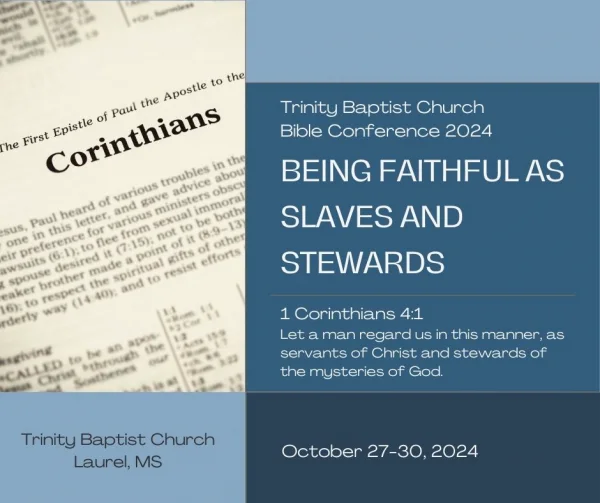
Trinity Baptist Church Bible Conference 2024 - Faithful as Slaves and Stewards
Faithful to Prech the Word

2 Timothy 4
Sermon Study
2 Timothy 4:1-5 charges the church and its leaders to be faithful to preach the Word. The sermon presents steady biblical preaching as God's ordinary means for strengthening, renewing, and building His church.
Primary Scripture
- 2 Timothy 4
Mentioned Scripture
- 2 Corinthians 4
- 2 Timothy 4
- Philippians 2
- 2 Timothy 2
- Acts 14
- Ephesians 4
Transcript
I want to thank Brother Neil for singing that one particular song. Brother Bill said it was a new song, "Make Me a Servant." I like that. I like the simplicity of it. I like the message of it. But that's what we're going to be looking at this week. I would make a request, Bill, if he can sing that Tuesday night. Is that possible? All right. You know, when pastors start getting people to change songs, it makes people nervous, especially the guys who are leading music. But I do like the message of that song. We're going to come back to that more on Tuesday night.
But if you would take your Bible, turn to 1 Corinthians 4, 2 Corinthians 4, verse 1, 2 Corinthians 4, verse 1, and then 2 Timothy 4, 1 to 5. That's where we'll be in our message. So just keep your Bible open there to 2 Timothy. Into the message, we'll read that passage out of Corinthians. Now before I get started, I want to thank you, Trinity Baptist Church. I want to thank Brother Bill for having me come this week. It's a great privilege. It's a great honor to minister to you this week and to preach God's Word. I'm not here just to preach. I'm here to minister to you in any capacity. And I don't take these things lightly.
We're dealing with God's church. We're dealing with God's people. We're dealing with eternal things. And also, I want to express to you how much Brother Bill means to me. He's already kind of stolen some of my introduction. I met Brother Bill, a deer hunting. My brother-in-law Patrick Skoggin brought him to our family place, and we deer hunted together. And I don't know how many years ago that was. It's been a few. I don't think we killed any deer, but we ate good food and had great fellowship, and we had a good time. But since seeing Brother Bill has become a great friend of mine, he's become a great encouragement to me.
And he's always been an encouragement until today. I think when he said something about me being a mentor, I don't know if I'm a mentor. I think he's making a comment about my age, and I'm a little older than him. I really dye my hair gray so I used to look older so I can act like a mentor. I don't know about a mentor, but he is a friend to me. And we encourage each other often. We talk about the work of the church and doctrine and scripture, and we preach at each other. And every time I hang up the phone, I am more encouraged. But honestly, I can just say it like this. Your pastor makes me a better pastor, and I'm thankful for that.
Now, before we really get into our verses, I want to say a couple of things about the week. I'm a pastor. That's what I do week in and week out. I am not an evangelist, and I'm going to preach to you like a pastor because that is what I do on Sunday morning. That's what I do on Wednesday nights, and that's what I do occasionally when we do have a Sunday night service. We normally have small groups or Sunday school on Sunday night, but sometimes I do preach on Sunday nights. But I've come to pastor you. I've come to come alongside Brother Bill and pastor you and help him pastor you.
I've come along to be under Brother Bill's authority because I am under Brother Bill's authority. And I want to encourage you to be here. I know we're all busy. Life's busy, but let's prioritize what is the most important thing, and that is God's work. That is God's work. I encourage you to be here. I encourage you to take notes. I encourage you to get the messages. They all go together. Brother Bill mentioned that you all are going to be doing a study called expository listening. We do that study in our church often. It is a very, very good study, and it helps you see your responsibility as listeners of God's Word.
And all of these messages are tied together, and I call you to expect things. I call you to expect that God's Word would change you. I call you to expect that God's Word would change your church, your pastor, in and all who would be here. Now enough of those kind of introductory type comments that are necessary, but they do take up some of our time. Isn't that right? Now before us, we have 2 Timothy in our verses for the morning. But before we get into the verses, I want us to see a little bit of background and a little bit of what's going on here.
The Apostle Paul was writing this letter to Timothy, who was the pastor of a local church, the church in Ephesus. But we need to see a little bit of who Timothy was. We need to see a little bit of his relationship to Paul, and what Paul was doing when he was writing these particular verses. It's believed that Timothy came to faith in Christ as a result of Paul's first missionary journey when he came to Lystra. You see that in Acts chapter 14. When he revisited Lystra on his second missionary journey, the Scriptures say that Paul took Timothy with him on his missionary travels. Young Timothy was many things to Paul. He was Paul's friend.
He was Paul's disciple and protege in the ministry. He was Paul's co-labor in the ministry. He was even Paul's successor in ministry, although Timothy was not to be an apostle. He didn't take his place as an apostle. To give us an idea of how important Timothy was to Paul, Paul told the Philippian church that he wanted to send Timothy to them. And listen to what he said about Timothy. He said, "For I have no one like him who will be genuinely concerned for your welfare." That's Philippians 2.20.
In other words, of all the men that Paul discipled, and there were quite a few, and of all the men that he partnered with in ministry, we can say that young Timothy was the best that Paul had. I don't know if you realize it, but that's a very tall order, a very tall order. But we need to see what's going on here as Paul wrote 2 Timothy, the second letter, 2 Timothy. After Paul was released from his first Roman imprisonment, Paul returned to many of the cities and the churches that he administered in before. And one of those churches was Ephesus. And when he was done in Ephesus, Paul left young Timothy there to be the pastor of the church.
Paul appointed Timothy to pastor the church, and he appointed him to set things straight in the church. We have to remember that the church in Ephesus was the flagship church of the region. It was one of the most important churches because of its rich history, but also because of its great influence in the region. It was after Paul left Ephesus, and when he was in Macedonia, that he wrote his first letter to pastor Timothy. Of course, that's the letter that we know of first Timothy.
And about two or three years later, during his second imprisonment when he was chained in a cold jail cell with no hope of being set free, we see that in 2 Timothy 2, 9, 2 Timothy 4, 6, and 4, 13, Paul wrote young pastor Timothy this second letter. Now it is important for us to see and understand that young Timothy was a real pastor. He was a pastor, and he was pastoring a real church, the church at Ephesus. And everything that Paul wrote in 1 Timothy and 2 Timothy pertained to local church life, and it pertained to Timothy's responsibility as the pastor to set those things in order.
And in this second letter, Paul did two things besides give young Timothy instructions on what to set straight. First he urged young Timothy to come to Rome to see him as soon as he could, but then second, and more importantly, he passed the mantle of ministry on to Timothy. He passed the baton of non-apostolic ministry on to Timothy, this young but very capable protege in the ministry. So in 2 Timothy, we have the last letter written to young pastor Timothy as he was pastoring this church there in Ephesus. And in chapter 4 of 2 Timothy, Paul gave pastor Timothy what can be seen as his most important instruction.
Paul charged Timothy to relentlessly preach the word. Yes, Timothy was to set things right in the church, and Paul addressed many problems in both of his letters, but Paul knew that the first and most important step in setting those things right was to preach the word because it was the word and the preaching of the word that would correct all of those things. Simply of all of the important things that Timothy was to do, and there were quite a few, preaching the word was the most important. I don't know about you, but I have a tendency to think on things and ponder on things, but think about it.
All those problems in the Ephesian church could have been corrected, and the standards and the commands pertaining to church health established. How? From the Word of God. The Word of God tells us what a healthy church should be. The Word of God corrects all the problems in the church, and so for Timothy and the church at Ephesus, straightening out all that came from the preaching of the word. So let's finally get to our verses. 2 Timothy 4, verses 1-5. Paul says, "I charge you in the presence of God and of Christ Jesus, who is to judge the living and the dead, and by his appearing in his kingdom, preach the word.
Be ready in season and out of season, reprove, rebuke, and exhort with complete patience and teaching. For the time is coming when people will not endure sound teaching, but will have itching ears, they will accumulate for themselves teachers to suit their own passions, and will turn away from listening to the truth and wander off into myths. As for you, always be sober-minded, endure suffering, do the work of an evangelist, fulfill your ministry." Now out of these verses, I want us to examine two big, two basic and broad things.
First Paul's charge to Timothy, we see that right away in verse 1, and then second Paul commands Timothy, and there are quite a few commands. All these commands are simple and they all go together. So we'll look at Paul's charge and Paul's commands. So let's start off with number one, Paul's charge. Number one, Paul's charge. Now if we look at the King James Version in all of the respected modern translations that we use, we will see that they all use this word charge. "I charge thee," the King James says, "therefore before God." But we need to ask, what is this charge? Is Paul talking about charging Timothy a fee? Is that what he's saying?
We have some men in the life of our church who are military. Is Paul talking about a charge like a military attack? Is that what he's talking about? Well this charge is a command. It is a commission. This is a charge, a commission, or a directive, but it's related to a task, it's related to a job, related to a responsibility. This charge or commission is related to a calling and a directive associated with a particular job and a particular calling. I'll give you a little bit of an example. Most of you know that I have a nephew that attends here, Tom Skogit. Right now he's getting real nervous. Tom is a fireman.
As a fireman, he has a charge, a directive, a command. A fireman has a charge to go into a burning house if need be. They go to a burning house. They go up into a burning house if they have to. Think about it. A fireman runs from a house fire instead of two and possibly into that house fire, he is neglecting, he is abandoning his charge, his commission, his directive. Now the charge for a fireman is very serious. It's life or death. But Timothy's was much more serious because Timothy's charge was related to his calling into the gospel ministry. More specifically, this was a charge relating to his call to pastor of the church at Ephesus.
This charge had to do with eternal things. But notice, this charge was from Paul. Here the language is clear. Paul was giving Timothy this charge, this directive. Paul was calling, charging. Remember his young protege in the ministry? We have already seen that Paul was passing the baton of the mantle of ministry to Timothy. Of course, Timothy was not to become an apostle, no. But in many ways, Timothy was taking over for Paul. So Paul the mentor was charging young Timothy his protege. Paul the apostle was giving young pastor Timothy a directive that was related to his gospel call and his responsibilities as a pastor.
But then notice this charge was from God. The text says that Paul gave Timothy this charge, a directive in the presence of God and Christ Jesus. Now scholars tell us the original language can read in the presence of God, even Christ Jesus. But notice the text does not say this charge is from God. This charge was from Paul, but in the presence of God. So how can we say that this was from God? Well it was God who called and appointed Timothy to gospel ministry in the first place. And it was God who called and appointed Timothy to study under Paul.
So the apostolic mentor Paul gives young protege pastor Timothy a very serious charging call and this was from God. Now before we get into the charge, I want you to, I want us to see what's behind the charge. First Timothy was a born again man. He was a converted man. He had true biblical saving faith. I stated earlier that it's believed that Timothy came to faith in Christ when Paul visited Listeria in Acts 14. But if you study Timothy, he had a godly, if you study Timothy, he had a godly grandmother and a godly mother. But what I'm trying to show you is this. Paul said that he was sure that Timothy was converted to Christ.
In second Timothy 1.5 he said that he saw a sincere faith in him. But then second, Timothy was called of God in the gospel ministry. Gospel ministry under Paul and then ultimately pastoral ministry. In first Timothy 4.14 Paul called pastor Timothy not to neglect or to be careless with his gift and his calling. He references when the council of elders laid their hands on him and this was signifying that God had indeed called him and signifying that the elders of the church saw the calling, they affirmed the calling, they embraced the calling. Now what is my point here? This is all very important. Timothy was receiving a specific charge.
But Timothy was a born again, God called man. Now let me tell you how I feel about this personally as a pastor. I do not have much for anyone who calls themselves a pastor, says they're in ministry, whether they're a pastor or in any kind of ministry and they cannot tell you two things. First when God saved them, how God saved them and the fact that they live that God saved them and second that God has called them to that office and to that position. I'm going to revisit this a little later so hold on to that. But then third, he says that he would give an account to God for how he reacted to the charge. Look back at verse one.
I charge you in the presence of God and even Christ Jesus, notice, who is to judge the living and the dead and by his appearing in his kingdom. Now this is simple. Paul was reminding pastor Timothy that he would give an account to God for all of these things. He was reminding Timothy that God would judge the living and the dead, which is a way of saying that God will judge all people. So Paul was reminding young pastor Timothy that he would surely give an account for his life and his ministry and for the charge and the directive that was before him. Now when I'm preaching in my church, I sometimes say, let's take a step back.
So let's take a step back from what I've unfolded. We have Paul's charge, his command to young pastor Timothy. It was a serious charge because it came from God. It doesn't get any more serious than that. And this was a solemn charge because this related to his call in the gospel ministry and his call as a pastor there in the church at Ephesus. And this was a serious and solemn charge because one day, one day he would give an account for how he received and obey these things.
Now we're going to get into the charge in detail here in just a minute, but I want you to see that this charge, this directive, how it applies and it applies to your pastor first. Then it applies to you, Trinity Baptist. So first this charges for Brother Beal because he will tell you that God has called him in the gospel ministry and more specifically, he will tell you that God has called him to be right here at Trinity Baptist Church. Think about it. If God's not called him, why is he here? So this charges for Brother Beal, just like it's for me. And then second, this charges for you Trinity Baptist.
This charges for you Deacons because as a church, you would say that God has called Brother Beal into the ministry. You would affirm his conversion to Christ. You would affirm and say that God's called him to be your pastor. So right here and right now, I want to call you to do two things. I want to call Brother Beal to reaffirm his calling and his call to this church. I mean, if God's not called us to do these things, what are we doing? He's my friend, he's my brother, but I'm calling him to reaffirm this calling and this charge and Trinity, I'm calling you to reaffirm that to Brother Beal.
You know, folks, sometimes our pastors don't get enough encouragement. Maybe you need to go to him and say, pastor, you're my pastor. I affirm you in it, pastor. I'm behind you all the way. Maybe you need to do it in the form of a card. I remember quite a few years ago when our church had gone through a series of difficulties, I was a little bit on the low side. One Christmas, someone gave me an envelope and it had a check in it for $1,000. That $1,000 check was nice. It went straight to pay some bills, but there was something else there that meant more than that $1,000.
That was a very encouraging note and the man said, me and my wife are behind you 100% and they underlined it. Affirm you, pastor. And look, church, for me, I take this charge very serious. I say these kind of things in my church. It's not my church, it's God's church. And look, I take this series because my entire life since November the 2nd of 1997 has been controlled and dictated by this call and this charge. Well what's the charge? We'll see. Next. Number two, Paul commands. Number two, I want us to see that Paul commands. Let's look at verses two to five. Notice what he says. Preach the word. Now he unfolds it all.
Be ready in season and out of season, reprove, rebuke and exhort with complete patience and teaching. For the time is coming when people will not endure sound teaching, but having itching ears they will accumulate for themselves teachers to suit their own passions and will turn away from listening to the truth and wander off into myths. Ask for you. In other words, don't worry about them. Ask for you, always be sober minded, endure suffering, do the work of an evangelist, fulfill your ministry. Now within these verses Paul gives Pastor Timothy nine commands. Yes. He gives five commands in verse two and four in verse five.
And this is how we're going to approach these commands. We're going to quickly examine all nine of these commands. And I want us to see what each command means and how they are all related. And we will see how these commands relate to you, relate to me, relate to brother bill, relate to all of us. Command number one, preach the word. This is simple. Paul commands Pastor Timothy to preach the word. And there are two specific things when he's seeing the command. First the word preach. This word preaching the original, it means to be a herald even to have the position or the office of a herald.
Now scholars in history tell us that in New Testament times a herald held the office as the Imperial messenger for the emperor. And the herald had the responsibility to go into the streets of the city making official announcements. He would make announcements pertaining to government events and politics, government laws, and even things like when the emperor or government officials would make public appearances. Maybe anything the emperor wanted announced or proclaimed, the herald would go into the streets loudly proclaiming those things to the people. But then second, this word word.
Now whereas the meaning of the word preach took a little explanation, what Paul is referring to here is real easy. Paul was simply saying, Paul was simply speaking of the word of God. But he was not referring to part of the word of God. In the original, the word that's used here speaks to the entire message of the written word of God. So notice command number one. Paul charges Pastor Timothy to preach the word, to be a herald of the word, and to be a herald of all of God's word. Command number two. This is what I call be ready, willing, and able at all times. Now this command is a little longer.
It may need a touch of explanation, but it's really simple. The English Standard Version says, be ready in season and out of season. The King James Version says, be instant in season and out of season. But here Paul says, be ready. And this means to be prepared, and it carries with it a sense of urgency and seriousness. And he goes on to say, be ready, the King James says instant, be ready in season and out of season. This simply means to be ready, prepared, and serious when it is convenient and when it is not convenient.
So command number two, Paul charges Pastor Timothy to be ready, willing, and able with seriousness and urgency when the time is right and when it is not right. Now before we continue, notice how this applies to me. If I'm preaching, I got to apply it to me first. Notice how this applies to any man who calls himself a pastor. I am to preach the word, not part of the word, but all of God's word. Brother Bill, as your pastor, is to preach the word, not part of the word, but all of God's word. Now there's a term that gets used in this pulpit. I heard it this morning. The term expository preaching.
That means you take a book of the Bible and you go verse by verse, sometimes word by word, sometimes phrase by phrase. You take the book of the Bible and you put the plow deep and you just go and go and go and you don't worry about how long it takes. I'm in the book of Hebrews and the life of our church and some of the men will make jokes and say, we might be here two or three more years. But then behind it, they'll say, pastor, keep doing it. You know, sometimes as a pastor, you know you need to address topics, certain needs, certain struggles. See, it's called dealing with the pulpit and the preaching of God's word with balance.
I've known guys who are expository preaching experts, you know, they think it's all expository preaching. Well, if some tragedy happens in their church, they're going to preach on it. Well, that's what your pastor does and that's what he should do. And this is to be done with a sense of urgency and readiness when it is easy and when it is not, when it's convenient, when it's not, the pastor is to preach and look church, this is the standard. This is the standard you should expect from your pastor. Now I want to touch on two words before I continue the word urgency. I thought about that a little bit.
The only way a pastor can have urgency, urgency in his preaching is if it's in his heart. You can't fake urgency. You can't make urgency mechanical. It's a hard thing. And the next word is the word readiness. He's got to be ready to preach. But you know, one of the great downfalls to many pastors and they can't be ready to preach with urgency like they should. You know what it is? Business. And you know what, where the business can come from? You. Yeah. Now I'm getting personal. If you busy your pastor to death, you will not have time, you will not have a pastor who has urgency in his preaching and a readiness in his preaching.
He'll always be a day late and a dollar short in his preaching. And I challenge you, Trinity. But busy your pastor to death. Give him the space and the time to be urgent in his preaching and to be ready in his preaching. Now these next three commands are really short. I will quickly explain them and kind of combine them because they really go together. Command number three, reprove. And this simply means to refute or to correct or to convict. Now let me give you an example. When someone is in error or in sin, we who love them and we love God's word use the word of God to refute and to correct that error and that sin.
The command number, command number four, rebuke. This simply means to go one step further than reprove. To rebuke simply means to correct the person when they are in error or sin. But then to press them with the desire to bring them to a place of guilt and repentance. Let me continue with my example. When someone is in error or sin, we who love them and love God's word, we use the word of God to refute or correct their error or their sin. Then we rebuke the person who is in error or sin or both with the desire for them to see their guilt and to move towards repentance. And then the next command, command number five, exhort.
This simply means to admonish someone, which has the idea of calling someone to their duty and obligations in the matter. But it can also mean to encourage. So command number three, command number four, command number five. Paul charges Timothy to reprove, rebuke and exhort. When there is error or sin, he was to reprove, refute and correct that error, that sin. And then he was to rebuke the one that was in error or sin with the purpose of bringing them to a place of guilt and repentance. And then he was to exhort them and encourage them by calling them to their duty to receive these things and obey these things.
Now, have you noticed something? The kind of preaching that Paul is calling Timothy to is real personal. In our culture, we call it stepping on toes. If your pastor doesn't step on toes, if the pastor doesn't get into your life, if the pastor doesn't get into your thought life, if the pastor doesn't get into what's going on in your heart, if the pastor doesn't deal with sin, he's not being like we see here. Now let's take a step back here and see what Paul was doing. God through Paul charged young pastor Timothy to preach the word.
As a herald with an official office and message, Paul directed him to preach all of God's word and to be ready to do so when it was easy and when it was not, when it was the right time and when it was not the right time. As an official herald for God, because he was called of God and appointed by God, he was to preach the word and to be ready, willing and able at all times to preach all of God's word and in his preaching.
God charged Timothy to reprove, to rebuke any and all sin and error and those involved in the sin and the error, brothers and sisters in Christ, leaders in the church, anybody in the church, any and all, he was to reprove and rebuke the sin and the sinner as well as exhort them and encourage them to repentance, to obedience to God and the truth of God's word. That is biblical preaching. Now there's some that can say it better than me, a little prettier than me, but that's biblical preaching. But notice how pastor Timothy was to do the work. This is very important now.
At the end of verse two, we see that Timothy was to do these things with patience. The King James says with long suffering. I like that. The new American standard says with great patience. You see that in the verse? This simply means that Timothy was to preach and to do all these things in his preaching to the people. Remember, this is a real church. He was to do all these things with the people there in the church at Ephesus with unfailing patience.
He was to patiently endure with them as God's people, any and all in the church, even those who are struggling with sin, even those who are strong, even those who are falling, he was to endure long suffering patience in all of these things. You know, there's no such thing as a godly pastor who's just a jerk. There's no such thing as a godly pastor who's strong arms, folks. See a godly pastor is patient. How you doing, pastor? Patient? You know, that's hard. Can I tell you why? We're sinners too. We're sinners too now. Church, this is what's expected out of your pastor. This is the standard. Pray for his patience. Pray for his patience.
Look, I'll be honest with you. I've come to realize something at our church. See folks, I preach like this at our church. But there are two kind of people that visit our church. Those who will come in the door and now say, "Wow, where's this church been?" But then there's another kind who will say, "Wow, where's the door? I want an easy sermon. I want a 20 minute sermon. I want to feel good." Two kind of people. Which kind of people are you? Do you come saying, "Wow? I can't believe I get to hear God's word like this." Do you come here saying, "Wow?
I get to hear God's word divided from me?" Or in your heart of hearts do you say, "Wow, where's the door? I can't wait to go home and eat." Now notice verses three to four. It's all about a warning and an explanation. Let's read verses three to four. "For the time is coming when people will not endure sound teaching, but having itching ears they will accumulate for themselves teachers to suit their own passions and will turn away from listening to the truth and wander off into myths." Now there's quite a lot here, but I'm going to briefly explain it.
Here Paul explains to Timothy that a time will come when people will not accept and endure sound preaching and teaching from God's word. Verse three says, "For the time will come when they will not endure sound doctrine." And this word endure, it means to hold up, it means to sustain, it means to bear. So Paul was warning Pastor Timothy that a time will come and is coming when people will not accept, they will not bear under, they will not hold up sound preaching and teaching from God's word. So he says they'll just leave the church. Is that what the text says? I didn't know what the text says.
Paul says they will not accept, they will not bear or hold up under sound teaching, so they will gather up too and they will gather up teachers that will teach what is pleasing to their ears and what will satisfy their own sinful desires and their own sinful errors. And notice that here in verses three to four we have two warnings and an explanation that applies to us. First the warning and the explanation that some will not accept sound teaching. There certainly are and there will be some who will not endure sound teaching and sound simply means that which is healthy, that which is well, that which is good. Sound means biblical.
Now folks I want you to do something. Look, take notice when people leave, where do they go? Now some will leave for the right reasons, but take notice of where they go. They very well may be going to another church that will tickle their ears and the devil always give you plenty of churches that will do that. Second the warning encouragement to make sure that this pulpit and all your preaching and teaching is sound, that word sound is key. Sound means healthy, it means well, it means good because it is biblical. Now I want to ask you a question, don't answer it.
Is the pulpit, the pulpit of this church sound, is Brother Bill's preaching sound? I didn't say good. I didn't say great. Is it sound? Brother Bill's job is it to be good. Brother Bill's job is it to be great. Brother Bill's job is it to preach like your favorite preacher. Brother Bill's job is to preach sound, biblical, healthy sermons. I'm going to go a little step further here. What about your Sunday school material? Is it sound, healthy, and good and biblical? I've seen churches that had a sound pulpit, but they had three or four Sunday school classes that taught some of the most horrendous stuff imaginable.
What about those who fill in when Brother Bill's out? What about those who preach at special events? Is it sound? Is it biblical? I'm not talking about good and great. Is it healthy? Is it biblical? And my challenge to you, Brother Bill, you draw a line in the sand and you do not allow any man to stand behind this pulpit unless they're preaching as sound and biblical. As preachers, those who fill in, they should be saved. Remember Timothy? Born again. If you have a man preaching, they should be able to tell you when God saved them how God called them and they should be sound. And look, I am thankful by God's grace.
I have a few full of men at our church who can preach. My problem is who am I going to ask? And it's by God's grace that he's brought them there. And I'm thankful when I'm out and they preach, our people don't just leave. Now the next commands are real short. And notice these commands, they're more personal to Pastor Timothy, but these things are connected to the previous five and they definitely apply as well. Command number six, be sober minded. The King James says, be watchful in these things. The English standard says, ask for you always be sober minded.
Now if we know what it means to be sober, we know that this means to be free from drunkenness or alcoholic beverages. But we need to see that Paul was not speaking about alcohol. Paul was simply using this metaphorically so as to charge Timothy to be clear minded, clear thinking, in control of his thinking, stable in his thinking. Command number seven, endure suffering. Now all of the translations say the same thing, endure hardship. And this phrase comes from a word in the original which means to suffer and to endure in suffering in relation to suffering evil. Command number eight, do the work of an evangelist.
Now what Paul charges Timothy here may seem odd, but as we will see, this fits right in with where Paul was going. Here Paul charged Timothy to do the work of an evangelist, but he did not call him to be an evangelist like we see in Ephesians 4.11. Simply this is what Paul was saying. He was charging Timothy to faithfully proclaim the saving message of the gospel within his ministry. Yes, he was to preach and to teach all of God's word to the saints there in the church at Ephesus, but he was to faithfully evangelize the lost with the saving message of the gospel, those within the church and those without.
You know when you go to a new church, you always notice the things that are different, right? When I came up here and stood here, I thought, "Wow, Brother Bill's pulpit's different than mine." I noticed this big microphone right in front of me. If you come to our church, you'll notice we do some things different, maybe some things you might think are odd, but one thing we don't do is I don't give a traditional invitation. I'm not against an invitation, but it just doesn't fit in with what we do.
But I'll tell you what, if you do come, you will hear that when the text that I'm preaching allows, I work hard to call the lost to the saving message of the gospel. At times I give a very personal plea. I beg people to come to faith in Christ. I especially do it at the close of the service. Now why do I do that? I've even had people kind of make fun of me at times for doing that. Look, church, every chance there is, the man in the pulpit should call the lost to Christ and to the cross to be saved because it is the pastor's job and a calling from God to do the work of an evangelist inside the church and outside.
Command number nine, fulfill your ministry. Now this is really the simplest and the easiest of these commands to understand. The apostle Paul was charging his young protege, Pastor Timothy, to do one thing here. Paul says fulfill your ministry, fulfill or bring to completion the gospel ministry to which you were called, fulfill or bring to completion the pastoral ministry to which you have been called to. Fulfill your ministry. One of the saddest and maddening, maddening things that I've seen through the years is so many that I know who have said they were called into the ministry to quit. They go do something more convenient.
They go do something that will give them more benefits. They move on to something with more opportunity, something easier. They just quit. To me, they do not fulfill or bring to completion the ministry that they say God called them to at one particular time. They say God saved them. They say God called them. They say God put them in a particular place of ministry, but they quit. You ever notice these guys never go on to something tougher? It's always something more convenient and better. They all don't quit. Fulfill your ministry. I've had times where I wanted to quit. There's times I really wanted to quit.
I confess there was a time I went through a real difficult time in the church and I remember thinking Lord, what can I do to provide for my family to get away from mean people? But I didn't quit. So let's take a step back here and see what Paul's doing. Paul charged Pastor Timothy to preach the word and while he was doing all this work in preaching, he charged him to be clear minded, clear in his thinking and judgment. He charged him to endure suffering from evil because of his preaching in his ministry.
He charged him to do the work of an evangelist in his preaching to reach the lost and he charged him to fulfill, to bring to completion the ministry that he was called to. Now at this time I want to transition and I want to make some quick application by asking a question. Why? Why is this preaching the word as Paul charges so important? I'll be honest with you, I had quite a few more reasons but I want to give you two. Number one, preaching God's word is necessary for the salvation of lost sinners. Times 10, 13 to 15 says, "For everyone who calls on the name of the Lord will be saved.
How then will they call on him to whom they have not believed? And how are they to believe in him of whom they have not heard? And how are they to hear without someone preaching? And how are they to preach unless they are sent? As it is written, how beautiful are the feet of those who preach the good news." So Paul is showing us that anyone and everyone who calls on the name of the Lord will be saved but they can't call on Jesus to be saved if they've never heard about Jesus. Someone must preach to them. If you've got children in your home, have them under the preaching of God's word every chance you can.
If you've got teenagers in your home, have them under the preaching of God's word every chance you can. How are they going to come to faith in Christ if they don't hear the gospel? I know I'm going a little long but you need this. You know there's a debate with a lot of churches, a lot of people. Can you play travel ball on Sundays? There's a debate with a lot of churches. People are busy. We need to cancel certain things at church. I know those debates. But I want to show you something. The debate today is about travel ball or not. The debate today is about do we cancel certain things or not. But let me tell you something.
The debate tomorrow will be different. The debate tomorrow is Christian persecution. The debate tomorrow is will you come to church when your pastor could be arrested for preaching truth. The debate tomorrow could be this. Could you be arrested for being a professing Christian? The debate tomorrow could be could you lose your job and your livelihood? And if you can't handle the debate of today, you will not handle the debate of tomorrow. What am I aiming at? We're talking about the salvation of souls, folks. There's got to be under the preaching of God's word. Let me circle back around.
I don't give a traditional invitation, but when someone's baptized in our church, they stand down front and give their testimony. They write it out. Every time they say the same thing, the preaching of the word, a small group lesson, I heard Brother Chris say this, somebody else preached, it's the word of God doing the work to bring that lost center to faith. Number two, preaching God's word is necessary for the sanctification of the saints. Look back at our verses.
Paul says, I'll charge you in the presence of God and of Christ Jesus, who is to judge the living in the dead and by his appearing in his kingdom, preach the word, be ready in season and out of season, reprove, rebuke and exhort with complete patience and teaching. Here Paul is showing us that these real believers, remember it's a real church, these real saints, speak strong and in the middle. They needed God's word. They needed all of God's word. And here Paul is showing us that the church needed young pastor Timothy to preach all of God's word to them for what purpose?
They needed pastor Timothy to preach the word like we see here for their personal and corporate sanctification. Look if you're a believer, the most important thing in your life is your personal sanctification. Yes you study God's word on your own and you should, but there's no substitute for being under the preached word of God. If anything, we need more of it than less of it. Now I want to close real quick. I want to quickly mention Timothy's context in ours. Here in second Timothy chapter four, Paul says that his life in ministry was about to be over. He said in verse seven, I have fought the good fight. I've finished the race.
I've kept the faith and he was passing the mantle of gospel ministry to Timothy. We can say that pastor Timothy was picking up where Paul was leaving off and Paul passed the mantle over to pastor Timothy. He gave him the most important charge as he did this. And this is what Paul is saying. I'm putting it in my words, Timothy, I'm almost done. I'm at the end of my race son and you're taking over. I charge you to preach the word. Do all the things you've seen in me. Do all the things that I have commanded you, but make sure you preach the word. And this is the charge for brother Bill. Look brother Bill, God saved you.
God's called you and God's brought you specifically to Trinity Baptist Church. Teach the word and deacons and leaders, Trinity Baptist Church. This is what God expects of you. Now, if you want to close your Bible, that's good, but I want to end with a personal testimony. I've lived this. In 2010, God led me to take a church that was almost closed. When I say almost closed, you have no idea. First of all, it was on the backside of the back 40. It was in the corner of the county that everybody forgot about. The church was old. We didn't own the property and the building was falling apart. I couldn't get the stink smell out of it.
There was a hole in the fellowship hall floor that I patched over and over and over. One of the men of the church made fun of it. He said, you know, every time I step over that whole pastor, I feel like a possum is going to come out of that hole. When I went there, it was eight people. The only two men that were there, they were so old they could barely grunt. They had no deacons, no elders, no Sunday school. They didn't have enough money to turn on the air conditioner at times, and so sometimes they turned on the old attic fans. Remember attic fans? But God led me to take that church.
When my children walked in the door, the children's ministry tripled. There was one little girl. I was bivocation. They only met on Sunday morning. And the first thing I did was, I said, we're going to have Sunday night and I'm going to preach God's word. We're going to have Wednesday night and I'm going to preach God's word and we're going to pray. And that's what we did. There was no reason for people to come, folks. The building was old. It was way out in the middle of nowhere and all I did was preach and preach and we loved on people and God started working. God started building. God started growing.
We experienced the rebirth of the church and it came on the back of doing what we see here. And I didn't really preach a lot of good sermons. It's rare if I do. I just preach sound, biblical sermons. And it works. Now for the sake of time, we're not going to turn to Corinthians. But I'll tell you how we're going to deal with Corinthians, that verse, chapter 4, verse 1. We're going to deal with that Sunday, Tuesday night. We'll come back around and tie all this together. So let me pray. I want to commit these things to the Lord. It's a lot, I know. I'm going to turn it over to Brother Beale.
We're going to come back tonight for a message that's going to surprise somebody. I'll just go ahead and tell you. But these two go together. spray.