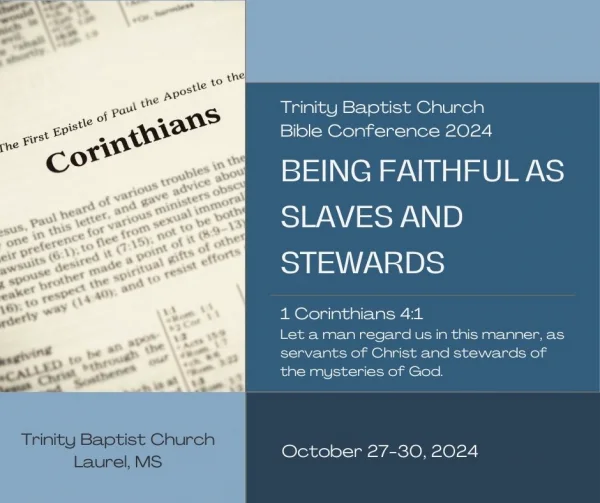
Trinity Baptist Church Bible Conference 2024 - Faithful as Slaves and Stewards
Faithful to Small Group Ministry

Ephesians 4
Sermon Study
Ephesians 4 and Acts 2 show small group ministry as part of equipping the saints for the work of ministry. The sermon calls every member to minister through healthy, vibrant small groups that build up the church.
Primary Scripture
- Ephesians 4
Mentioned Scripture
- 1 Corinthians 4
- Acts 2
- 3 John 1
- 1 Corinthians 14
- Titus 2
Transcript
I want to make a comment about something we were singing earlier. Some of you maybe know that old hymn, "Footprints of Jesus." Did you grow up on that one? That's one we sing in the life of our church. We kind of call it that our mission song, because we want to go wherever the Lord Jesus leads us. Wherever His footprints take us, that's where we want to go. I appreciate that, Brother Neal. Well, if you would take your Bible, I want you to turn to two places tonight. Turn to Ephesians 4 and mark your place there. Ephesians 4 verses 11 to 14, and then turn to Acts chapter 2. We'll be there in the beginning of the message, verses 42 to 47.
Now, I know that the theme verses for the week come out of 1 Corinthians 4, verse 1 and verse 2, and I promise we're going to get there. I had it on my mind, had it in my notes to read that at the end of the message this morning, but I just felt like because of time, we needed to kind of wait on that, but we're going to jump into those verses in 1 Corinthians 4, not tomorrow night, but the next night. So we'll get there, I promise. But tonight will be in Ephesians 4, but we'll start off in Acts 2. But I want to also thank you for making me feel at home. Brother Neal made that comment about making us feel at home.
We are both from here, my wife and I, born and raised here, but we don't come back to do ministry much. I don't come back to do ministry much. I usually come to see family. But thank you for making us feel at home. Thank you for your hospitality. Brother Bill's taking good care of us. We got to have a good supper last night, and my wife got to be with Kelly, and we got to talk about family and life and encourage one another. Thank you for providing us a good room, and somebody put a good gift basket in our room, and I made a terrible mistake.
I ate a good lunch, and somebody put some beef jerky in there, and I ate just about all of it this afternoon. So if I seem lethargic, it's because of somebody else's fault. They put the basket in there. But I thought about hospitality. That's commanded in biblical. If you study 3 John 1, you'll see hospitality in there. It's a man named Gaius who was complimented for being hospitable for those traveling pastors. And that's what I am, I guess, this week. Is that what I am, Brother Bill? Yeah, that's what I am. So I appreciate it. Well, let's get to our message.
Now, this morning, we looked at what I called "Faithful to Preach the Word." That's what the message was all about this morning, faithful to preach the Word. And tonight, I want us to see something that flows out of and something that is connected to the preaching of the Word. Tonight, I want us to see that which flows out of and that which is connected to the preaching of the Word. Now, I'm going to go ahead and tell you this message is going to surprise you. On the front end, the beginning of the message, I think some of you may discount the message.
But on the back end, I think some of you, I hope many of you, will see the seriousness and the great need for this message. But tonight, I want us to see that which flows out of that which is connected to the preaching of the Word, and that is every member of the Church, every member of the body, every member of the Church ministering in and through small group ministry. Now, I'll go ahead and tell you, I may call it Sunday School. I may call it small group ministry. It's all the same. We have what we call small group ministry in the life of our Church. You can call it Sunday School. I know you all have Sunday School. It's all the same.
So if I say one phrase and then another, I'm not really confused there. I'm talking about the same thing. Now, I'm going to show you what should be coming out of and connected to the preaching of God's Word, and that is the Church is to be organized into smaller groups and every member of the body, every member of the Church ministering in that small group ministry, and ministering out of that small group ministry. So this morning, it was all about faithful to preach the Word, and tonight, it's all about faithful to small group ministry. You can call it Sunday School ministry, either one. Faithful to small group ministry.
Now, this is how I want to approach the message. I want to do two basic things. First, I want us to see that dividing the Church into small groups for the purpose of ministry is definitely seen in the Scriptures. We see this at the birth of the New Testament Church. We're going to look at that, and then we see it later on when the New Testament Church is what's called more fully developed. And then second, I want to give us some particular teaching that we all need to better equip every member of the Church, every born-again believer, every member of the body of Christ, to equip them for the work of small group ministry.
Now, I know what goes on in some people's minds, and right here, there might be somebody saying, "Wait a minute, Pastor. "You're telling me that Sunday School's found in the Bible?" Well, I will not say that Sunday School is many of, many of us have seen it as found in the Bible, because much of what we have seen and experienced in Sunday School is not biblical. Actually, much of what we have experienced in Sunday School is extremely unbiblical. If we all started to come make a list and compare lists, we would probably have some war stories. I've seen a few.
But I am confidently saying that the Church organized into smaller groups for particular biblical purposes is certainly found in the Bible, and I can prove it to you, and I will. Now, in the message, we're going to look at the Church organized into small groups. This is going to be from Acts 2, verses 42 to 47, and some other passages, and then we'll look at every member of the body, every member of the Church, equipped for the work of ministry, and that is out of Acts, or excuse me, Ephesians 4, verses 11 to 14. Now, let's read our verses, Acts 2. Acts 2, verses 42 to 47, and we'll get there to those verses here in just a minute.
It would help if I had my page turned. We know these verses. "And they devoted themselves to the apostles' teaching, to the fellowship, to the breaking of the bread, and to prayers. In all came upon, in all came upon every soul, and many wonders and signs were being done through the apostles. And all who believed were together, and they had all things in common, and they were selling their possessions and belongings and distributing the proceeds to all, as any had need.
And day by day, attending the temple together and breaking bread in their homes, they received their food with glad and generous hearts, praising God and having favor with all the people, and the Lord added to their number day by day, those who were being saved." So number one, I want us to see the church organized into small groups. The church organized into small groups. But before we really get into these verses, I wanna show us something else that's important. From the scripture, we see the church should be organized.
Now, before we get into the text, before we dive into the verses, in zero in on some specifics, I want us to see that God is a God of order and organization, and God desires that his church be organized and orderly, and it is to be organized according to what God says in his word. In Titus one, verse five, or the beginning of verse five, Paul says to Titus, "This is why I left you in Crete, "so that you might put what remained into order." Here we have Paul telling Titus why he left him there on the island of Crete. Titus was to put things in order in the churches.
There were certain things that were out of order, so Paul appointed Titus to put those things in order. And in Corinthians, 1 Corinthians 14, 40, Paul says, "But all things should be done decently "and in order." Here we have Paul giving the Corinthian church some basic and much needed instruction. The Corinthian church was plagued with many sins, but one that Paul was addressing was horrible disorder in the church, and particularly disorder in worship.
So Paul wrote all things, so Paul was writing here saying that all things in the church, especially worship and worship services, should be done appropriately and in an orderly manner, and he went on to tell them what was appropriate and orderly. Now, what is my point here? What is my point in referencing these two passages and circumstances, and not just getting into our Acts 2 portions of scripture just yet? We need to see that God is a God of order. He is a God of order, not a disorder. And God expects his church and his churches to be organized in a certain way so as to function in a certain way and in an orderly way.
Now, there's a big lesson here for us. The church is to be structured. The church and the structure of the church should be ordered, and it should be ordered and organized according to God's word. It's God's church. It's not my church. It's not Brother Beale's church. It's not your church. So God's church should be ordered and organized according to the way God says, and we see that in God's word. And the church should function according to that particular structure. I'll give you an example, one that you will not have a problem with. You don't believe in women pastors. Beale's taught you thoroughly there. Now, that's a big problem today.
Brother Beale can help you there. But you don't believe. We don't believe in women pastors because the scriptures forbid that. It's obvious. So what we have there is order and function. It's order and function. Women are not to have those positions and those roles and function that way. And you don't have a problem with that one and we don't either. But here's a big question for you and for me now because what I'm preaching here applies to me and our church as well.
If through the preaching of God's word, God showed you, God showed us that your church was out of order, that my church was out of order, not structured according to God's word and not functioning according to that structure, would we change it? Would we change it? It's God's church. That's the question. But now I want us to see that the New Testament church was definitely organized into smaller groups for the purpose of certain biblical ministry. And I have an example. We've read our verses. Now here in these verses, we have a basic description of the church where?
In Jerusalem, just after the New Testament church was born, if you do some study, you'll see that some say that here we have the church in its infancy and I agree. But even in its infancy, we see more organization and structure than we may realize. But let me give us a bit of background here. In Acts two, we see that on the day of Pentecost, the Holy Spirit of God was poured out as was promised. Then Peter stood up and he stood forward, stepped forward, and he preached the gospel to the great crowds of Jews that were gathered there in Jerusalem, there at the temple during the Pentecost celebration.
And Acts two 41 says that through those events, about 3000 souls were saved and then they were baptized and they were added to the body of believers. That's the church. Couple of things here. Brother Bill and I were talking about this passage last night at supper. And it's not a stretch for us to call this the first Baptist church of Jerusalem. They baptized them, right? The first church there in Jerusalem, right? I know it's not in the scripture. I know, but that's what we have. But oh, look at this church growth, folks. That was just a handful of believers there at the beginning, but 3000 souls were saved on that day.
And the text says that they were added to the body of the believers after they were baptized. Now, this reminds me of someone that I knew years back that was in the life of our church. He used to say, and he said it confidently, that when a church grew to 200, that it should divide into smaller churches because the pastor could not pastor a church larger than 200. You know, I thought about that a lot. I guess he couldn't have been a member of the church of Jerusalem. He couldn't. Well, there was not one pastor at the church of Jerusalem pastoring all of those people. There was the whole group of God called me and the apostles.
And then later we see it developed into other elders. But what am I trying to show you here? There is a really big lesson there, and it's not just humorous. Beware of being smarter than God. See that individual thought he was smarter than God. He thought he knew better than what we see in the scripture. And there's a big lesson there. It's easy for us to see some who think they're smarter than God, but we can't be smarter than God either. So in Acts two, we have the birth of the church, and particularly we have the birth of the local church in Jerusalem.
And even though we have the church in its infancy, we certainly do see certain organization and structure in this basic description of the church in Acts two, 42 to 47. Now notice that verse 42 says that they, that would be the believers, over 3000 of them, they were constantly devoted to certain things. The King James Version says, and they continued steadfastly. So they were constantly steadfastly devoted to the teaching of the apostles, to the fellowship of the believers, to the breaking of the bread and prayer.
And verse 46 says that day by day, they met together at the temple, they broke bread in each other's homes, and they did these things how? With gladness and generosity. So notice what we see in these two verses. First, they gathered faithfully in larger settings to be instructed by the apostles. Scholars tell us that when these believers gathered in the temple, they used the temple as a place of assembling together for instruction and ministry. And this teaching and instruction came from the apostles. So it is obvious that as they gathered to gather in the temple, the apostles taught them the word of God. Now think about it.
Where else could large crowds gather then? They had the capacity there for large crowds. And these Jews who had just been converted to Christ had not broken away fully from Judaism. So it was natural and normal that these recently converted Jews still gathered at the temple. And it was here in these large gatherings that the apostles taught them the word of God and instructed them in ministry. Second, they gathered faithfully for prayer. Scholars tell us that these recent Jewish converts still attended and participated in the appointed Jewish times of prayer. They were Jewish converts.
So attending the appointed times of prayer at the temple was normal. That was natural. But no doubt, their prayers were much different because they had come to believe that Jesus was the promised Messiah and they had savingly believed in him. But then third, they gathered faithfully to participate in the Lord's Supper. Here we see that they devoted, they were devoted to the breaking of the bread. Now this can refer to regular meals, and I believe it does. But scholars tell us that this also can refer to the Lord's Supper, and I believe it does. But then fourth, they gathered faithfully in one another's homes for food and fellowship.
Here we see that these recent converts and those original first believers, they met in the homes of those Jews who lived in and around Jerusalem. This is simply the church breaking down into smaller groups for many of the purposes that we see here. Isn't it obvious? I mean, it's right there. For a church of 3,000 or more to meet in homes, wouldn't they have to break down? Wouldn't they have to have organization? Wouldn't they have to think about these things? Yes. So out of verse 42 and 46, we see organization, basic structure, and we see the church function in certain ways according to that organization and structure. Can you see it?
Here we have a church of over 3,000. They met in larger settings. The text says they met in the temple together. They met in smaller settings. The text says that they met in each other's homes, and they met in these settings to do the things that we see in the verses. So right here, we have proof that the church at Jerusalem was organized a lot like we are at Grace Life Church Brookhaven and a lot like you are here at Trinity Baptist. And they met together a lot like we do. But church, I want you to see something. If you oppose Sunday school-- you ever know somebody that opposed Sunday school?
If you oppose breaking down the church into smaller groups, then you are opposed to what the church at Jerusalem did. You couldn't have been a member of that church. You're smarter than God. Now, I'm not talking about what goes on in Sunday school. I'm not talking about now what goes on in our small groups in our church. No. I'm just talking about breaking down the structure, you see? And if you discount Sunday school, if you discount small group ministry, you are discounting something that was vital to the church at Jerusalem. We can't be smarter than God, folks. We can't be smarter than God.
I guess those who do oppose it, those who minimize it, just ignore these kind of things, they're just smarter than the apostles, because they were involved in these things. Now, at this point, I want to address the skeptic. There might be someone here that is a little bit of a skeptic. There might be someone who needs a little more convincing. Now, because of time, I'm not going to turn there. I'm going to give you an assignment. You go study Titus chapter 2. This is when we see the church more developed, but Titus chapter 2. But here in Titus, we have the church.
Not in its infancy, like we see in Acts 2, but we see the New Testament church was much more mature and more developed. But it's amazing. In Titus chapter 2, we see the very same thing that we see in Acts chapter 2, but it's described in a lot different way. In Titus chapter 2, verse 1, we see preaching and teaching from Pastor Titus. Paul says to Titus, but as for you, teach what accords was sound doctrine. Remember, Titus was the pastor of those churches on the island of Crete. So what does he say? Preach the word. Isn't that what we saw this morning? And then from verses 2 to 10, you see a breakdown from the larger to the smaller.
You can call it Sunday school or small group, anything. But Titus chapter 2 looks different than Acts 2, because Paul here addresses gender. You see the responsibility for the older to teach the younger. Specifically, older men teaching and influencing younger men, older women teaching and influencing younger women. You see it? If you're a skeptic now, I don't know what I can do to convince you. You're ignoring a lot of scripture. Right. Now, I'll just tell you what we do at Grace Life Church, Brookhaven. We have women with women and men with men. Now, why do we do it? We see it in Titus 2. But we do it practically for a practical reason.
Think about it. Women relate more with women. If you've been married for five minutes, you know that women relate more with women. You better say amen. Practically, women relate more with women. And men relate more with men. And there are things that women need to deal with, with women, and women only. And there are things that men need to deal with, with men only. I think about a particular example that I know of. And anything that I'm sharing has been shared publicly. So I have permission. It's one of the ladies in the life of one of our wiser, older small groups.
She shared about her difficult upbringing, some of the abuse that she went through. She talked about how God had saved her, how God had healed her from all of that, how God had worked that out and even caused difficulty in her adult years, even in her marriage. This is women with women. She would have never shared that if men would have been in the room. I think about one of the men's groups I was in one night. One of our older men, one of our wiser men, was looking around the room at some of those younger men. And he looked them right in the eye. And he called them on the carpet. And he talked about this word we use called pornography.
He talked about how in his younger years, how he was addicted to pornography, and how God saved him as an adult, and how God delivered him, and how those things were wrecking his marriage in the early years. He never would have talked about those things if women would have been in the room. I think about something that I heard from one of our younger ladies' groups. One of our young ladies is dealing with infertility, having some procedures. I heard about it. She spoke about it. How she shared that with those ladies. Oh, they had a lesson that night, but they cried together and prayed together, cried together and prayed together.
One of our young men, one of our young couples in the life of our church, they got a little girl that's got some difficulties, born with some difficulties, had cancer. His name's Evan. And her name is Devon. Strong young couple. They love the Lord. And I think about how I hear that Evan shares with those young men. And they all encourage him and love on him. But I hear about all kinds of ministry that comes out of those small groups. I hear about all the connections that they make throughout the week. I listen to them talk about things they're talking about over the phone. Bible studies are studying together.
I hear them talking about how they get together at lunch. I hear what we call body life going on. And I see ministry going on. Here a while back, we had a family that was visiting our church. They weren't members. And her brother died. Her name was Rita. She was very faithful. They've since moved on to another church. Rita was very faithful in the life of her small group. And I went to the funeral home, Brother Bill. Well, I went to the funeral. It was at the church. And I stood in line. And in front of me were two of the ladies in our church, in her small group. And they started talking to Rita. And I thought, Bill, I'm in the way.
I spoke to her. Hey, how you doing? I was in the way. I went on out the door. Why? Because those ladies were there to minister to that lady. Oh, I minister to her. But I couldn't minister like them. Now, let me tell you my opinion and my position here. I believe-- and I see that I have scripture to stand on this when I say this. In the life of the church, I believe that the faithful preaching of God's word is the number one thing that we should do, the number one thing that the pastor should do.
And I believe that being faithful to the ministry of small groups-- call it whatever you want-- I believe that having small group ministry and being faithful to small group ministry and biblical ministry in and through small groups is the number two thing that we should do. If the church at Jerusalem needed small group ministry, look, folks, it doesn't get any better than 3,000 souls being saved. It doesn't get any better than having the apostles as the pastors.
But if the church at Jerusalem needed small group ministry and the churches there on Crete needed small group ministry, so does Trinity Baptist Church and so does Grace Life Church Brookhaven. [INAUDIBLE] I hope it's OK, but I'm going to read to you our small group ministry strategy statement. And if you can, compare it to what we read in Acts chapter two. Listen to our strategy statement. The church organized in the Bible study small groups is to minister the word, meet individual needs, equip the saved, provide fellowship, as well as help organize the laws.
Kind of sounds like what we see in Acts 2 verses 42 to 47, because that came from Acts 2, 42 to 47. You know, folks, if we get to the place where we'll just plagiarize what we see in the scripture, we'll be pretty good. But I want to continue in these verses. We've got a little more ground to cover. Acts 2, 42 to 47. Now here, I want to make a couple of observations about what we see in verse 43, 44, 45, and 47. Here we see demonstrations of the Holy Spirit of God. And the Holy Spirit of God is empowering these believers and equipping them to do and to participate in certain works. Now let me explain.
Here in verses 42, 43, 45, and 47, we see demonstrations of the Holy Spirit empowering the teaching of the apostles. We see demonstrations of the Holy Spirit empowering their fellowship, their partaking in the Lord's Supper, and their prayer. We see demonstrations of the Holy Spirit empowering them in their meeting together in the temple and in smaller groups. Really, we see demonstrations of the Holy Spirit empowering them in how the church was structured and how the church functioned. Simply, the Spirit was working in the church. But this was not random out of thin air. This was in and out of how the church was structured, you see?
Now notice the demonstrations of the Spirit in these believers in these things. I'll move quickly through here. First, all came upon them all, verse 43 tells us. This word all really means respect. It means a healthy fear, really even a dread. This was a great sense of reverential fear that goes well past respect. And this reverential fear fell upon those inside the church and outside the church. And this happened because of the great things the Holy Spirit of God was doing through the apostles and through the church. Then second, they enjoyed great unity.
Here in verse 44, we see that all these believers were together or unified as opposed to being divided or against one another. And this unity was because of a work of the Spirit of God in them and in the work of the church, but especially in them as believers. Then third, they met one another's needs, sometimes sacrificially. Did you see that in verse 45? Here we see the next step in their great unity. As each of them had needs, they stepped forward to meet those needs. And when necessary, they made great sacrifices to meet the needs of brothers and sisters. Fourth, they enjoyed favor with all the people.
Verse 47 tells us that as a result of all of these things, they enjoyed the favor of the people outside the church, but not for long. Eventually, a great persecution arose against the church and it scattered them. And that was a blessing from God because when they scattered, the work of the church went with them. Then in fifth, the Lord was saving lost sinners daily. Here we see something very simple, but great and profound. Verse 47 says that God added to their number daily, those who were being saved. Simply, God was saving lost sinners daily. Now question, what do these things mean to us? And specifically, what do these things mean to you?
Your Sunday School ministry and our Sunday School ministry or small group ministry at Grace Life Brook Haven. We cannot do the work of Sunday School without being empowered by the Holy Spirit. We're gonna talk more about Holy Spirit empowerment tomorrow night. We need the Holy Spirit. We can't be afraid of the Holy Spirit. The Holy Spirit is the third person of the Godhead. We need the Holy Spirit to empower us and enable us to do what we see we must do from the scripture in small group ministry. Listen again to our small group strategy statement.
The church organized into Bible study small group is to minister the word, meet individual needs, equip the saved, provide fellowship as well as help evangelize the lost. So what happens? If you are empowered of God in these things, if you are empowered and equipped by the Holy Spirit, then the word of God is taught in your Sunday School. Oh, it'll impact those sitting in those seats. If you are empowered when we work to meet the needs of those that are small groups or Sunday School, well, the Holy Spirit will use our efforts to build great togetherness and unity among the people.
If you are empowered, then an environment for true and meaningful fellowship will be built and maintained. If you are empowered, you will be equipped and empowered to help one another to work, to evangelize the lost in the church, in each other's families and in each other's lives. So the point I'm making here is this. We're going to look at this more in an in-depth way tomorrow. Yes, but you, we desperately need a work of the Holy Spirit of God to help us. So what do we do? Pray, confess sin, live Holy Spirit controlled lives. Tomorrow night I'm gonna talk about being filled with Spirit.
We expect God the Holy Spirit to work and we depend on God the Holy Spirit to work. Sunday School teacher, are you praying for the people in Sunday School class? Are you praying for the work? Do you labor over that lesson? Sunday School class member, are you praying for your teacher? Are you praying for those in your class? Do you just show up? Do you pray over your lesson? Do you pray for one another? And are we looking for this kind of work in our Sunday School class or in our small group ministry?
Or are we just meeting for Bible study and talk about how bad Tennessee football is and tell a few deer hunting stories? - I'm done. (audience laughing) - Now at this point I wanna give us some particular teaching that I believe will better equip us for the work, okay? And this is where we're changing into those other passages. Now let's take a breath now, okay? We really need this. So number two, this is what I'm calling equipped for the work of ministry. Let's turn over into Ephesians chapter four, verses 11 to 14. Ephesians four, verses 11 to 14.
And he, he here is God, he gave the apostles, the prophets and evangelists, the shepherds and teachers to equip the saints for the work of ministry for building up the body of Christ until we all attain to the unity of the faith and of the knowledge of the Son of God to mature manhood to the measure of the stature of the fullness of Christ so that we may no longer be children tossed to and fro by the waves and carried about by every wind of doctrine by human cunning, by craftiness in the deceitful schemes.
Now out of these passages, I wanna make several observations that definitely apply to us in Sunday School Ministry, small group ministry, what we've been looking at from Acts two and Titus two. But first notice, God gave leaders to the church, verse 11. Here in verse 11, we see that God gave certain named offices and men in those offices to the church. Apostles, prophets, evangelists, shepherds or pastors and teachers. Now we need to make sure we understand what we have here. God gave the apostles, but they are dead. Or their offices of seat and their offices ceased when they died, but they do live on in the writings of the scripture.
So we do not have living apostles, but we have the apostles in our day in the teaching and the authority of the New Testament scripture. And then the New Testament prophet. In their day, the New Testament prophet literally spoke the word, the thoughts and the plans of God. And most scholars believe that the office of the New Testament prophet died off when the apostles died. There was, there was and is no need for the New Testament prophet because God has spoken to us in our day through his completed word. But like the apostles, we do have what we have, we do have what the New Testament prophets gave us is found in the scripture.
So that leaves the rest. Some debate at the office of the evangelist exists today, but I have no reason to believe that it does not. Simply the evangelist is one who is appointed and equipped by God to travel like a missionary and to preach the good news of the gospel and see the laws come to faith in Christ. Then we have the shepherds and teachers and language scholars tell us that this phrase refers to one person in one office, two gifts and giftedness, but one office. This is the one who is called and equipped by God to shepherd or pastor the church, as well as teach and preach God's word to and in the church. So notice what we have here.
Today we have the evangelist and we have the shepherd teacher. Some pastors like to refer to this as pastor teacher. You might wonder why John MacArthur calls himself a pastor teacher, comes right out of this verse. And more specific to the local church, we have the shepherd teacher, or as we would say the pastor, the pastor is called and gifted to pastor the church and to teach the word of God in that particular local church. And what does he teach? We learned this morning all of God's word, isn't that right? And a great biblical example of a New Testament pastor was young pastor Timothy there at the church at Ephesus.
So notice what God has given you, Trinity Baptist Church. Brother Bill, you can call him pastor Bill. You can call him pastor teacher. That's what he is. That's the office that he holds. So you have pastor, shepherd, brother Bill, and he's here to pastor you, shepherd you, and to teach God's word to you. And then we see that God gives other men in the life of the church to come alongside with him. If you go on and study, you'll see that there are other men who are in that elder position as well. But then second, God gave leaders to equip the saints. We see this in verse 12.
Here we see that God has given these leaders, these men in these offices as gifts. To do what? Verse 12 says, "To equip the church and individual believers." And to equip means to complete. To equip and bring the members of the church more and more into spiritual completion. Now notice how this works or how this should work. Through pastoring and shepherding you and teaching you God's word, all of God's word, you as a born again saint of God, you are equipped. You are being equipped, which means you are becoming more and more complete. Do you see? More and more while the faithful preaching of God's word is very important?
Some of you are nodding your head, you're getting it. Here is a question, a rhetorical question. Have you grown more and more spiritually? Have you been equipped more and more through Brother Beals preaching and teaching, through Brother Beals pastoring you? And look Brother Beal, you think about the saints of God that God's put under you here. You keep on faithfully preaching God's word, Brother. Because through God's word and through your preaching and through your shepherding, God is equipping them and completing them and equipping them and completing them.
But I wanna say this to you, if you're not being equipped and completed, there's something wrong. For someone to sit here in the life of the church for 20, 30, 40 years and never grow and become completed, more and more completed, there's something wrong. Now let me continue because of time. But third, why does God do this work of equipping the saints? The second part of verse 12 says that God is doing this work in the saints in you so that you would be equipped for the work of ministry. Oh, look back at verse 12, Ephesians 4. Let's read verse 11.
And God, that's what he is, and he, God, gave the apostles, we have their writing, and the prophets, we have what they said, what God wanted in the scripture, the evangelists, the shepherds and teachers, why? To equip the saints for the work of ministry for building up the body of Christ. Look, Brother, look, Sister, look, saint of God, God is equipping you for ministry. Who should minister and help in children's classes in the life of the church? You. Who should minister and help and minister to teenagers? It's you. Who should help and teach in Sunday school ministry? It's you. Who should help and serve in vacation Bible school ministry?
That's you. Who should help and serve in the life of the church? It is you. Sometimes ladies to ladies, sometimes men to men, but sometimes it's all of us together. Now, let me say something real personal to you now. I was speaking to you, Trinity. Brother Bill is not hired to do the work of ministry. That is not biblical. And if you do that to him, he will not be ready, willing and able to preach like we saw this morning. He is hired or called to equip you and to complete you for the work of ministry. That's what we see here. I know it's hard for some churches to get out of that mindset.
If you will release your pastor to do what you see strictly in the scripture, your church will grow, you'll grow. God will do great things in the life of the church. If we structure, if we're structured and we function according to what we see in the scripture, God will bless. Now let me continue. Listen again to our small group strategy statement. The church organized in the Bible study small groups is to minister to the word, meet individual needs, equip the saints, provide fellowship, as well as help evangelize the lost. And look, brothers and sisters, God's word tells us that you have at least one spiritual gift, if not more than one.
And you have gifts and you have giftedness that has been given to you by God and all of those things are combined and brought into your life for the work of ministry in the local church. Your gifts, your abilities, your talents, your resources, your time, and all of your spiritual gifts all together. But then fourth, what for what purpose? Verse 12 says that the purpose of this equipping and working is to build up the body of Christ. The saints are to work in the ministry so as to build up the body. That is this church, this church, this body, individual believers in the members of Trinity Baptist Church.
It's a sad thing, brother Bill, but this is true. There are some brothers and sisters here at Trinity. They're not built up as they should be because some of you are not working in the ministry of Sunday school as you should. You see? Every member of the church should be in ministry now. Every member of the church, which means the saints are equipped to do the work of the ministry so that the body of Christ, this local church will be built up, built up. Again, there are brothers and sisters in the life of this church. They're not being built up as they should because some of you are not working and serving like you should.
Oh, but some of you are. Some of you are working, you're serving, you're ministering. And God is using you to build up other believers and the church and one another. But then fifth, for what goal or what are the goals here? Here in verses 13 to 14, we see the goals for equipping the saints for the work of ministry. I'm not gonna read the verses because of time, but here we see several goals. I wanna quickly zoom through these. The first goal until we reach the unity of the faith. This speaks of a unity or a oneness when it comes to the body of revealed truth, which is the gospel and all of God's word.
So one goal of this work is so that all in the church would be one in the gospel and one in all of God's word until we reach the unity of the knowledge of the son of God. Now this does not speak of salvation, but of a deep and personal knowledge of Christ Jesus personally. So another goal of this work is so that all the saints in the church would be unified or worn in their personal knowledge of Christ Jesus until we reach the stature of the fullness of Christ. This speaks of the fullness or a greater and greater fullness of the qualities and the characteristics of Jesus.
So another goal of this work is so that all in the church would possess more and more the qualities and characteristics of Jesus in their personal lives until we become more mature, reaching the maturity of spiritual manhood. This speaks of growing to a place of maturity that is all grown up like boys grow up into a man. So another goal of this work is so that all in the church reach a spiritual maturity that is seen as all grown up in the Christian maturity until we all leave behind, until we leave behind spiritual immaturity.
Here the one who is tossed to and fro and carried about is the immature believer who is not grounded in Christ and the word of God. This means that they are prone to be influenced by bad doctrine and bad teachers. So another goal of this work is so that all in the church leave behind spiritual immaturity, which makes them prone to bad doctrine and bad teachers. Now this leads me to a question, and this is a big one. Have all of the members of Trinity Baptist Church, have all of you reached a oneness in the gospel and the word of God? Have all of you reached a unity and a oneness in our personal knowledge of Jesus?
Have all of you reached a oneness in our maturity? Which means all are being grown up, grown up in Christian maturity? Have all of you reached a unity and a maturity so that none are tossed here and there by bad doctrine and bad teaching? Has the entire body, the entire membership of this church reached these goals? Sounds like you got a lot of work to do. We got a lot of work to do at Grace Life Church at Brookhaven. As long as one member of the body has not reached these goals, then there's a lot of work to do.
And as your pastor, Brother Beale, Pastor Teacher Beale has a lot of work to do because he is to equip you for the work of the ministry. And there's plenty of work of ministry to do. And look folks, this work is never completed. These goals are never attained because we're all sinners. We're all sinners. So we must always be working on this work and because God brings new believers in the life of the church, so we're always working. So God gave and gives certain leaders, the pastor teacher using the writings of the apostles and all of God's word to equip or complete the saints for the work of ministry in the body, which is the church. Why?
For what purpose? To build up the body until we all reach and maintain the goals. Oneness in the faith and the word. Oneness in our knowledge of Jesus. Oneness in the fullness of the characteristics and qualities of Jesus in our lives. Oneness in Christian maturity and spiritual manhood. Oneness in maturity where none of us are swayed or affected by bad doctrine and teachers. Honestly, we have some great goals to attain. We have some great goals to attain in Brookhaven and here in Trinity. Now notice what we've seen here tonight.
First, the biblical example and standard of biblical small group, Sunday School ministry, whatever you wanna call it. I think this is a standard. I believe that a church without any small group ministry like we see here is an unhealthy church. And then second, our responsibility and responsibilities in the work of the ministry. In this work, the work of this ministry in different places in the church and especially small group ministry. Now I shared with you our story about the rebirth of our church this morning.
About how we saw God graciously take a church that was almost closed and we had the rebirth of a church and it was built on the preaching of the word. But let me tell you the part two to that is our church grew and grew. There came a time where we were deficient. We didn't have Sunday School ministry. We didn't have small group ministry. Now we had difficulties with our building. So we started small group ministry in our homes. Now that's wonderful and terrible all at the same time. It's great to have folks in your home until somebody's child gets sick. But we saw God starting to do a work there.
But our story is a story of the rebirth of a church that was almost closed, but in 2020, we relocated. Remember this morning I said we were on the backside of the back 40. Well, for several reasons, we saw that we were very, very limited where we were. We didn't own the property. The building was in very bad shape. All of our people came from Brookhaven and we didn't fight and divide and split, but we met and God graciously helped me lead our church to relocate. And we meet right in the middle of downtown Brookhaven now. Now this is rather humorous. We moved in March of 2020. Anybody remember what happened in March of 2020? We made it.
But when we moved, there were a lot of things that we did, but I'll tell you, we took small group ministry to the next level. And I'll tell you this, right behind the preaching of the word faithfully is vibrant, healthy, growing, small group ministry. We've gotten women with women, men with men, teenagers together, and I'm telling you, God is equipping the saints to do the work of the ministry. And brother Bill, I literally have to get out of the way. I have to just get out of the way. Now I'm minister to folks, but there are times I find myself in the way. And there are times I hear this, pastor, we didn't tell you, we got it.
The work of the ministry. So every member, every member ministering in the ministry of small groups, let me pray. And then I'll turn it over to brother Bill.