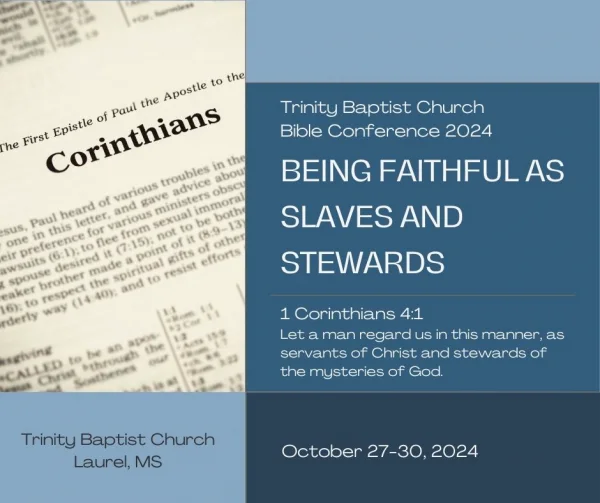
Trinity Baptist Church Bible Conference 2024 - Faithful as Slaves and Stewards
Faithful to the Filling and the Empowerment of the Holy Spirit

1 Corinthians 2
Sermon Study
Ephesians 5:18 and 1 Corinthians 2 connect the Spirit-filled life with Spirit-empowered ministry. The sermon teaches that ordinary church service, from teaching to serving needs, must flow from the filling and power of the Holy Spirit.
Primary Scripture
- 1 Corinthians 2
Mentioned Scripture
- 1 Corinthians 4
- Romans 8
- Ephesians 4
- 1 John 2
- John 14
- Acts 16
- Acts 18
- Matthew 18
- Matthew 28
- Acts 17
- Acts 6
- Ephesians 5
Transcript
[ Music ] [ Applause ] >> Abby, I appreciate that. If I could sing that good with a head coat, I'd sing all the time. I thought about that. I wouldn't want a head coat all the time. But I'd sing all the time. I do want to say something that Bill mentioned. He did mention some folks from our church are over, Tommy and Patty Aldermen and one of our college students slipped in. I see you, Drake. But I bring them to your attention for a reason, not just to thank them for driving over to be with us. But I want to say that everything that I am preaching, I have preached in our church.
I have known pastors and preachers who go places and they preach one thing in your church but they preach something different in their church. I've known those kind. I don't operate that way. I was thinking about it as I was sitting there. I've known Tommy and Patty for 20 years plus and they've been in our church for seven or nine years, seven or eight years right around in there. And he can verify that I preach these things in our church and we are working hard to live these things, okay? So I say that to say I'm not a hypocrite and I'm also saying that to say that we're all in this together. We are all in this together.
Now if you would take your Bible and turn to two places, turn to 1 Corinthians chapter 2, we will be in verses 1 to 5, halfway through the message or so. So you can mark your Bible, 1 Corinthians 2 verses 1 to 5 and then we're going to start out in Ephesians chapter 5 so you can just leave your Bible open there. But it is good to be back with you tonight. I pray that yesterday was a great Lord's Day for you. It certainly was for me and I want to tell you that I'm thankful for your attendance and for your attention to what I have been teaching and what we've been studying together.
I have heard some good reports that God's Word and the messages have been speaking to you and if the Lord has been and is ministering to you, I want to encourage you to do one thing. Go share it with your pastor. Explain that to him. Explain how the messages and what's been taught is working in your life and like I said, my goal is to come and to pastor you, to come alongside your pastor and pastor you and be up under him. We're just all in this together. Now I know that this week is all about being slaves and stewards like we see in 1 Corinthians 4, 1 to 2. I know that we have not gotten to those verses yet but we definitely will.
Tomorrow night, we will be looking at those verses in what I call faithful as slaves and stewards. Faithful as slaves and stewards. And I will tie the theme of the entire week, the theme of being faithful slaves and stewards to all that we are studying. I know I've said this, this all goes together. Now I want to challenge you to make sure you get all of the messages. I'm assuming, Brother Bill, that they are recorded. I do like messages being recorded. I'm thankful for messages. I benefit from messages being recorded. But church, listen, there's no substitute for sitting in the pew and hearing the word of God taught live.
I want you to think about that. This is not in my notes but I'm going to say it. Church, I challenge you, don't cheat yourself and think you can miss and catch up later. Now I know we're all providentially hindered, okay? Don't cheat yourself and do that. Back in our COVID days, we couldn't come to church. We had what's called church online. Isn't that right? I heard a preacher say it like this, that's like kissing your girlfriend through a screen door. Well, staying home and missing the service and catching up later is about like kissing your girlfriend through the screen door. Don't do it.
But I want to challenge you to get all these messages folks because they all do go together. Now, yesterday morning, we looked at being faithful to preach the word. And we saw that the number one priority of the church must be the preaching of the word of God. And we saw that the most important responsibility that the pastor has in the life of the church is preaching the word. Now my challenge for you, brother Bill and Trinity is this, let's recommit ourselves to the standard and the priority of the preaching of the word.
And there are a thousand and one things that'll come along in our lives and in the life of the church to distract us there. And last night, we looked at being faithful to small group ministry or Sunday school ministry. And we saw that God is a God of order. And we saw that the church at Jerusalem and the churches on the Island of Crete, they were structured so that they were divided into smaller groups to participate in and fulfill certain ministry. And church brother Bill and I were talking today at lunch about these things.
And we were both amazed that the church at Jerusalem with a membership of over 3000 folks, they organized the way that they did. And we thought about it. We talked about it. I mean, how much organization and time and effort and energy did it take to organize over 3000 and meeting homes? They had a plan. And I'm sure they had a good secretary or two to help them there. And not only did we look at the church dividing into smaller groups and the function of those smaller groups, we saw that the preaching of the word of God from the pastor teacher and other God called men is for the purpose of equipping the saints for the work of ministry.
Let me emphasize something. Of course, there are many places for you to serve in the life of the church, but the first place and in many ways the best place for you to serve and to start serving is in your Sunday school. Brother Bill gave me your Sunday school strategy statement. See, last night I used ours, but tonight I'm using yours. Your Sunday school strategy statement reads, "Our church, Trinity Baptist Church is organized into small groups or Sunday school to evangelize the lost, equip the saved, and provide fellowship and to meet individual needs." But I want us to see that we all have a problem.
We have a big problem and this is a critical problem. Just like me, Brother Bill or any pastor teacher that Brother Bill were to bring in here, any man that stands behind this pulpit does not have the power to save the lost, sanctify the saints, and equip the saints for the work of ministry. Just like me, Brother Bill, who is the pastor teacher here at Trinity Baptist Church, he does not have the ability to bring about any spiritual or eternal change in any person's heart and life.
Sunday school teacher, children's teacher, VBS teacher, anyone who teaches God's word in the life of this church, you do not have the ability to bring about any spiritual change or eternal change in any person's heart and life. We looked at the fact that all of the members of Trinity Baptist Church, notice I said all now, all of the members of Trinity Baptist Church are to be and should be equipped for the work of ministry.
And no matter who you are, if you are working to meet the needs of brothers and sisters in your church, if you are helping to equip the saved, participating in and providing Christian fellowship within the body, if you are well helping to evangelize the lost, you do not have any ability to do these things. We're totally unable to do these things. Now what am I trying to say? We do not have the power and the ability to do these things in and of ourselves.
So tonight I want us to see that we all have a great need, both on a personal and corporate level, simply we all need to be filled with the Holy Spirit and we need to be a spirit filled people in church and we need to be spirit filled so as to be empowered, so as to be enabled to faithfully preach the word and to faithfully minister in small groups or Sunday school and beyond. So tonight we're going to be looking at what I call faithful to the filling and the empowerment of the Holy Spirit. Faithful to the filling and the empowerment of the Holy Spirit. Now in our message we will look at three things basically.
First the spirit filled life, second the spirit filled ministry and then we will conclude by seeing the results of these things. I think you have come to realize that when I say we will look at three basic things that means there's a whole lot under those basic things. So let's get started. Number one, I want us to look at the spirit filled life. Number one, the spirit filled life. Now here is where I want us to turn to Ephesians but we're only going to look at one verse, one verse. Ephesians chapter five, I think I said chapter four earlier, if I did, I apologize but Ephesians chapter five, one verse, verse 18.
"And do not get drunk with wine for that is debauchery but be filled with the spirit. And do not get drunk with wine for that is debauchery but be filled with the spirit." Now before we get into this verse and how this applies to us, we first need to go over some basics. First and foremost, we must understand who the Holy Spirit is. The Holy Spirit is not a thing. The Holy Spirit is not an influence. The Holy Spirit is not some kind of a force for good. When I was teaching on these things in the life of our church, I made a personal confession here. I said that I had never watched any of the Star Wars movies.
And right immediately, I mean right there, some of the people in the life of our church thought I was un-American. Well, in the Star Wars movie, don't we have some kind of a force for good and a force for bad? Well, the Holy Spirit is not some kind of a force for good. The Holy Spirit is the third person of the triune Godhead. He is the third person of the Trinity. He is the Holy Spirit. He is God. One of my favorite systematic theology works is Wayne Grudem's systematic theology. And he gives a great definition here. He says, and I'm quoting, God eternally exists, says three persons, Father, Son, and Holy Spirit.
And each person is fully God, and there is one God. But next, we need to understand what happens when we come to saving faith in Christ. More specifically, we need to understand how we as believers relate to the Holy Spirit and how the Holy Spirit of God relates to us as believers. Simply when one comes to saving faith in Christ, certain things happen. Now, this is an incomplete list, but this is the basics. First of all, we are indwelt by the Holy Spirit. John chapter 14, verses 15 to 18, Jesus promised his disciples that he would not leave them as orphans.
He promised them that he would not leave them and that he would give them the Holy Spirit who was with them and who would be in them. And Paul says in Romans 8-9 that if anyone does not have the Spirit, that that person does not belong to Christ. Simply the one who does not have the Spirit is not born again. They are not converted to Christ because all true Christians are indwelt by the Holy Spirit. Also, we are sealed with the Holy Spirit. Ephesians 4, 13 and 14, tells us that when a person comes to saving faith, they are sealed with the promised Holy Spirit.
This means that when one is born again, the Holy Spirit comes to indwell the believer and as a result, the Spirit seals them, secures them and preserves them. Simply the one who savingly believes in Christ is sealed and secure. And verse 14 tells us that the Spirit is given by God as his pledge of the believer's future eternal inheritance in heaven. That's a big way of saying we believe in the perseverance of the saints. Christians don't lose their salvation. And we are anointed by the Spirit. Yes, anointed by the Spirit. Now, this can be confusing because of the abuse of these kinds of things.
But when one is converted to Christ, 1 John 2, 27 tells us that the Holy Spirit anoints that believer with the anointing of an abiding presence of the Spirit in them. This is simply another way of saying that the Holy Spirit comes to dwell within the believer. In 1 John 2, 27 and John chapter 14 and chapter 16 tells us that this anointing or this indwelling is for certain particular purposes. In 1 John 2, 27, it says this anointing is for the purpose of teaching the believer. And in John 14 and 16, we see that this anointing or indwelling is for the Spirit to be the believer's helper.
Also, he is the Spirit of truth who guides the believer into all truth. And he teaches the believer all things and brings those things into remembrance. Simply, this anointing is a special gifting of the Spirit for the purpose of helping, counseling, guiding, teaching, and even correcting the believer. Now, what is my point here? I want us all to understand that when we are converted to Christ, savingly converted to Christ, the Holy Spirit comes into our very beings, the Holy Spirit comes to dwell in us, and he anoints us for the purpose of teaching us.
He becomes our helper, our God, our teacher, who guides us into all truth and convicts us even of sin. Now, before we continue, I kind of want to say timeout. Some of you here, while I've been teaching on the Holy Spirit, have been a little nervous. I remember years ago in my seminary days, I had a professor that used to say, "Boys?" I don't know why he called us boys. We were grown men. He said, "Boys, the Holy Spirit..." Excuse me. He said, "Boys, the Pentecostals and the Charismatics have made us Baptists afraid of the Holy Spirit." Now, my point is this.
What the Charismatics and Pentecostals, what those others do in the abuse of using the Holy Spirit and the name of the Holy Spirit, all that stuff can't make us afraid of these things. So if we're a little nervous about this term anointing and Holy Spirit, don't be. I'm thoroughly biblical here. But why is this important? Why not just jump right into the verse? If we're going to see, understand and embrace the Spirit-filled life, then we must see and understand who the Holy Spirit is. And we must understand that He dwells in us and He works in us.
And look, folks, if you do not have the Holy Spirit of God living in you, if you are not sealed and anointed by the Spirit of God, you're not born again. Look, Romans 8-9, I referenced it earlier. Romans 8-9 says that if any person does not have the Spirit of Christ, he's not born again. Now let's get into the verse. And I want us to see two things out of verse 18. First the setting, and then second the actual command. So first the setting at the beginning of verse 18. Now simply the setting of this command was the original recipients of this letter, their pagan past.
Many of these believers in the Ephesian church have come out of paganism where alcohol was a major part of their sinful lives. And Paul was pointing out that they had been filled with and controlled by alcohol and other sins that were all tied to the abuse of their alcohol and all wrapped up in their pagan way of life. Simply drunkenness was a part of their past, and paganism and worshipping pagan gods was a part of their past. They worshipped many gods, and drunkenness and all sorts of sexual immorality was at the center of all of that paganism.
History and scholars tell us that they even had a god of wine and wine making and agriculture and fertility. These people had all kind of pagan gods. So Paul was pointing to their pagan past and how they were controlled and filled with drunkenness, which represented how they were controlled and filled with all types of sin and sinfulness. And he says, "Do not be controlled by that sin and by that sinfulness." Now I've got to pause here. Are you controlled by alcohol and drunkenness? There very well can be a man or a woman here, and you're a secret alcoholic. Drunkenness is a sin, folks. If that's you, you need help.
You need to come to see Brother Beale, and you need to deal with the fact that you're in sin. We cover over sin with all kinds of humanistic terms. We might call it alcoholism or drunkenness or whatever. Drunkenness is a sin. If that's you, you need some help. But another question, are you controlled by something else in your life? Something else that's sinful? I mentioned this last night, that touchy word pornography. Are you controlled by other sin and sinfulness? But you know what, brothers and sisters, we can be controlled by good things in life. Are you controlled by your job? Are you controlled by family?
I know people who have little boys and girls and they have their little precious family, and they're little precious babies, and their children control them. We can be controlled by sinful things, but we can also be controlled by good things. Those things are out of priority. We can just say it like this, those things are out of whack. But second, the command. We see it at the end of verse 18. Now, we already know that we, as believers, we possess the Spirit. He lives in us, He works in us, and He has sealed us forever. But here we see something entirely new. But a question, what is the Spirit that Paul is talking about here?
Now, you'll notice if you have a King James Version or a modern translation, you will see the word Spirit, not Holy Spirit. So who is this? Is Paul talking of the Holy Spirit? Yes. This is not the spirit of a man. This is not the human spirit. That is why your translation has the word Spirit capitalized. But another question, what does it mean to be filled with the Spirit? Now, to understand what Paul is saying here, we must understand the language. If we understand the construction of the language and the meaning of the word "field," what God expects here really unfolds for us like a flower.
So first, this is a command to be filled, and it is a present passive command. That means that this command has within it an ongoing work, which means this verse can read, "Keep on being filled and stay filled with the Spirit." Every now and then I'll look at the Amplified, which is a paraphrase. It's a good assistance and study. The Amplified says, "Ever be filled." And it's very accurate. So this is not a one-time filling in the past. This is a filling for today, for tomorrow, and for the future. But then second, this is a command to be filled, and it is a passive voice command.
This means that this filling cannot come from within or from oneself or even from another, which means this verse can read, "Let yourselves keep on being filled and stay filled by the Spirit." So this is not a one-time filling, and this cannot come from self or from another person. And then third, this is a command to be filled, and it is an imperative command. This means that this is not a suggestion. This is a command that God expects to be obeyed, and this is for all believers.
This means this can be translated, "I command all of you who are believers, let yourselves keep on being filled and stay filled with the Holy Spirit of God." So this is not a one-time filling, and this is not something that comes from self or from another person, but this is certainly a command which is expected to be obeyed. But another question, what does the word "filled" mean? I mean, we fill up a cup of coffee. This morning, honestly, I got tired of that weak dishwater coffee at the Hampton Inn. I like my coffee strong. If you can see the bottom, something's wrong with it.
Brother Bill picked me up at lunch, and I said, "Brother, take me to Starbucks. I want a cup of dark roast coffee." But does this mean to be filled like a cup of coffee? I mean, think about it. But another question, does this mean that we fall out into floor and speak in tongues? Does this mean we run around the sanctuary like we see on television? I mean, these are legitimate questions. But this word "filled," it had several meanings and uses in their day. This word spoke of the wind filling the sail of the ship, so that the ship could sail on the sea as the sail was filled with the wind.
This word spoke of something being saturated or soaked. For meat to be preserved in their day, it was saturated or permeated with salt. This word also spoke, was used to speak of being in total control, like when someone was filled with anger or rage or even hatred. So, now that we see the meaning of this command and the meaning of this word "filled," we can easily see what God, through Paul, was and is commanding here. When a believer is filled with the Spirit, there is a sense in which they are filled, so that they are guided in life day by day.
When a believer is filled with the Spirit, there is a sense in which their entire life, their entire being is saturated or permeated with the Spirit. When a believer is filled with the Spirit, there is a sense in which they are controlled by the Spirit. I know I mentioned the Amplified. It's not a translation, but a paraphrase. It's a useful tool. But right here, I want to offer my paraphrase of what God is saying here. God, through Paul, is commanding us, all of you believers, let yourselves be filled with the Spirit. Let yourselves keep on being filled with the Spirit.
Let the Spirit of God so fill you that He may steer and guide you on Monday, Tuesday, Wednesday, Thursday, even when you're on vacation, that He may saturate your life, even your entire being, that He may be in total control of all of you, of every area of your life, every day of your life, all of your life. But how is this to take place? I just said earlier that we cannot fill ourselves. I mean, how is this going to take place? So how does this happen? First, now that we're educated, we surrender to the work. We see this command. We see this expectation from God now. This is not an option.
It's not like God has like a serious Christian life or some and an okay Christian life for others. No. So we see God's command. We see God's expectation. So we submit ourselves to the work. And if we do not, we must see that we are rejecting the person of the Holy Spirit and the work of the Spirit. Simply, if we do not, we are in sin. Notice something. The fact that you see that the Spirit of God is God, you see that if you're rejecting the filling, you're rejecting God. Here's my challenge to you. You take what you're learning here and you go home and you surrender to the work.
You go to your prayer closet, you stay up late, you get up early. You take your Bible, you get on your knees and you surrender to the work. And then second, repent of sin, any sin that the Spirit of God brings to your mind, brings to your thinking, brings into your heart. Sometimes when we repent, we make restitution. Because sin grieves the Holy Spirit. You see, Ephesians 4.30 teaches us that sin grieves the Holy Spirit. And Ephesians 4.25-29 Paul lists the sin and the types of sin that grieve the Spirit. Now, here's my challenge here. Take Ephesians 4, take the scripture and find out what kind of sin grieves the Spirit.
And if the Spirit dwells in you, remember what we learned. He guides us in the truth. He teaches us, he convicts us. So if the Spirit is in you and you're going through that list and all of a sudden there's one in your life, bam, the Spirit has shown you. Third, we are to repent of empty, self energized religion and religious works. That is because those things are a sin. In fact, self energized Christianity, self energized Christian work, those things are far more sinful than you know. And those things grieve and quench the Holy Spirit of God according to 1st Thessalonians 5.19. And look, if we get honest as Baptists, we're good at this.
We're good. We're good at doing church. And so what I'm showing you is we must repent of self energized religious works. Now I have told you that I kind of have a habit of unpacking things and then say, let's step back. So let's step back and see what we have here. Simply, we are not to be filled with any sin or sinfulness. We are not to even be filled and guided by good things. We are commanded to, we are expected to, to be filled and always be filled and controlled by the Holy Spirit of God. Now here's some probing questions. How can you be a successful, faithful Christian if you are not living the Spirit-filled life? You can't do it.
How can you be a good Christian parent if you are not living the Spirit-filled, Spirit-controlled life? How can you be a good employee? How can you be a good boss or a manager? How can you be a good business owner? How can you be a good school teacher or a coach or a principal? How can you be a ditch digger or own the ditch digging company or anything if you're not living a Spirit-filled, Spirit-controlled life? And look, church, the biblical standard for the believer is this, that if you live a Spirit-filled, Spirit-controlled life, that's the biblical standard, that you live the Spirit-filled, Spirit-controlled life.
Now, my question, how are you doing here? So you don't have to answer to me because if you're born again, remember the Spirit dwells in you, He convicts you, helps you, guides you, so the Spirit of God is telling you how you're doing. And look, folks, I know that Brother Bill led you in a very difficult work in the life of your church. He led you as a church to cleanse the church rolls. Ah, now you're saying, "Ooh, you're bringing up some tough stuff." Now, why did Brother Bill do that work? Follow me now.
He did that because Brother Bill understands and knows that the church roll should reflect people who profess that they've been converted to Christ and they live it. Notice in our culture, somebody can be a member of the church and not come to church for 20 years and they'll still tell you they're saved. Well, the Bible doesn't say that. The Bible says they go out from us because they never were of us.
Brother Bill understands and knows that the church roll should reflect people who profess that they've been converted to Christ and they live it and they have been scripturally baptized and they are truly making a covenant with the church and the body as a member of that local church and of that local body. And look, church, that is just normal Bible Christianity. The idea of a Christian being a Christian and not being a part of the body, that's not found in the Bible. And the only reason that that seems so radical to cleanse the rolls is that church membership has become so subnormal in our culture.
And what should also become normal Christianity at Grace Life Church, Brookhaven, and Trinity Baptist Church is this, Spirit-filled, Spirit-controlled, born-again Christians. The reason that the Spirit-filled life sounds so odd to so many is because what is seen as the normal Christian life is so subnormal. So Trinity Baptist, let's make biblical church membership represent a whole bunch of born-again believers who are living Spirit-filled, Spirit-controlled, Spirit-saturated lives. Now I'm fixing to make a real big mistake as a pastor. See, there are two things that get you in trouble in life when you get off into religion and politics.
Well, as a pastor, you got to get into religion, so here we go. Donald Trump wants to make America great again. Let's make the Spirit-filled life and the Spirit-filled church member normal again. That's got to be normal, folks. But how does this apply to being faithful to preach the word and being faithful to minister in small groups? Well, I'm glad you asked it because that lets me go on. So number two, I want us to look at the Spirit-filled ministry. I want us to look at the Spirit-filled ministry. Now here's where I want you to turn over to Corinthians. First Corinthians 2, verses 1 to 5. Let's read those verses.
Tomorrow night we'll be over in chapter 4. And I'm going to mention chapter 4 here in a minute. First Corinthians 2, 1 to 5. Paul's writing to the church at Corinth. He says, "And I, when I came to you brothers, that can read brothers or sisters that were brothers, I did not come proclaiming to you the testimony of God with lofty speech or wisdom, for I decided to know nothing among you except Jesus Christ and him crucified. And I was with you in weakness and in fear and much trembling.
And my speech and my message were not implausible words of wisdom, but in demonstration of the Spirit and of power, so that your faith might not rest in the wisdom of men, but in the power of God." Now, before we jump into these verses, we need to quickly look at a few things. First of all, the background. If we look at the book of Acts, we can see the account of when Paul went to Corinth on his second missionary journey. After Paul had obeyed the Macedonian call, seen in Acts 16, he went into Macedonia to Philippi, Thessalonica, Berea, Athens, and he ended up in Corinth. And Acts 18 records what took place when Paul was in Corinth.
And when we look at how much time Paul spent in Corinth as compared to other places, we see that Paul stayed in Corinth quite a long time, and that was all a part of God's design. And in Acts 18, 9-11, the Lord spoke to Paul telling him not to be afraid that he was with him. And he even told Paul that he had many people in the city, so Paul stayed there some 18 months with great ministry success. And if we break down what we see in Paul's ministry in Corinth, that's seen in Acts 18, and we compare what we see in the Great Commission in Matthew 18, 16-20, we see some similarities.
In Matthew 28, verse 19, Jesus said, "Go therefore and make disciples of all the nations, baptizing them in the name of the Father, Son, and the Holy Spirit." And Acts 18, 1 tells us that Paul went to the nations by going to Corinth. And while he was in Corinth, many of the Corinthians here in Paul believed and were baptized. Chapter 18, verse 8. And he stayed there a year and six months, teaching them the Word of God, verse 11.
And in Matthew 18, 20, Jesus said, "And behold, I am with you always." And in Acts 18, 10, Jesus told Paul, "For I am with you, and no one will attack you to harm you." So, if we study what Paul did in Corinth, it would seem that he used the Great Commission for his marching orders. And the template and the instruction as to what to do in the ministry, they're in the city as well. Well, that's because that's what he did. Notice, church, it's almost like all the Bible fits together. Well, that's because it does. It seems like Paul read the Great Commission, and it seems like he just used the Great Commission as his pattern for the ministry.
That's because that's what he did. Look, church, I'm saying this because you need to see something just like I need to see something. We do not have to invent or reinvent what the church should do. All we have to do is copy what we see. All we have to do is read the scripture and do what we see. Far too many churches do what they do in the life of the church because they want to do what they want to do. What a question we've got to ask, and this is for Trinity and Grace like Brookhaven, are we reading the scripture and doing what it says to do? Are we?
Now, at this point, I want us to see that in our verses, Paul reminded the Corinthians of his philosophy of ministry while he was with him. He reminded them of what he did and why he did what he did. And I want to point out that Paul reminded them of three things. First, he reminded them of his personal approach to ministry, his personal approach to ministry. I want you to look at verses one to two with me.
"And when I came to you brothers," brothers and sisters, "I did not come proclaiming to you the testimony of God with lofty speech or high speech or wisdom, for I decided to know nothing among you except Jesus Christ and him crucified." Here, Paul contrasted himself to the pagan philosophers and teachers of their day who depended on their personal wisdom and their eloquence in speech to gain and to train their followers. And scholars tell us that Corinth was full of these worldly philosophers and teachers.
And if we look at Acts 17, when Paul was in Athens, we will see that Paul shared the gospel with many of the philosophers and teachers in the city. In verse 18 tells us that he shared with some of the Epicurean and Stoic philosophers, which was a type of court at the Aragopagus. But it was a well-known place, the Aragopagus. It was a well-known place where philosophers and teachers of the day, they meant to discuss and debate and lecture new ideas. But notice what Paul says right here. He reminds the Corinthians that he did not come to them with this superior or high speech that they were so accustomed to.
He did not come to them with human words of wisdom as he proclaimed the message and the word of God to them. In other words, when he came to them preaching the gospel and the word of God, he did not use a style whereby he used lofty speech and great words of wisdom. So how did he come? In verse 2 he said that his personal and ministerial approach was to know nothing among them but Christ and Christ crucified. And get this, if Paul had come to them with superior words using human wisdom as he proclaimed the gospel and the word of God, he would have been exalting self and not Christ.
Look, church, I am speaking to any who are in areas of service. I do not care if we are taking out the trash in the church. I don't care if we're preaching from this pulpit. It does not matter if we're helping with crafts and vacation Bible school, if we're serving on a committee or we're the chair of that committee, we must die to self and decide to know nothing in the work but Christ and Christ crucified.
Especially if we preach the word of God, especially if we teach, especially if we are in some kind of a leadership position, we've got to die to self and self effort and know nothing but Christ, know nothing but Christ and Christ crucified. And get this, that is not possible unless you live in the Spirit-filled life. It's almost like the Bible all goes together. Second, Paul reminded them of his personal attitude in the ministry. Let's look at verses three to four to see his personal attitude in the ministry.
"And I was with you in weakness and in fear and much trembling, and my speech and my message were not implausible words of wisdom but in demonstration of the Spirit and a power of faith." Here Paul reminds them that although he was an apostle, oh he was an apostle, uniquely chosen and called of God as an apostle, his attitude was that of a servant. Now we're going to look at this tomorrow night but over in chapter four verse one, Paul referred to himself as the lowest of slaves, the lowest of servants. He called himself a "huperatees." You know, I'm the kind of pastor that really quote Greek words.
You know what a pastor from the south that quotes Greek words sounds like? A pastor from the south trying to quote Greek words. I have a hard enough time as it is. But in this case we've got to touch on this word tomorrow night. He referred to himself as a "huperatees." In the original this word spoke of the lowest of lowest of servants and slaves. So Paul did not depend on himself nor did he make much of self. If anything he lowered himself and he did not expect the Corinthians to venerate him or to exalt him. He simply became nothing and he was nothing among them so that Christ may become everything through him and to them.
And because that was his attitude, he could truly say that when he was with them, notice how long he was with them, 18 months. He could truly say that when he was with them his preaching power did not come from him, but his preaching power was a demonstration of the Holy Spirit, the power of the Holy Spirit working through him. But notice one detail here. His attitude is clearly revealed in verse 3 and quickly that turned into his approach in the ministry. Notice that attitude approach. Growing up my daddy always said attitude determines action.
Meaning a day he disciplined me from my attitude because he knew what was going to happen in my action. So notice attitude and approach, attitude and action. Look at verse 4. "In my speech, in my message, were not implausible words of wisdom, but in the demonstration of the Spirit and a power." So look at his attitude and notice it determine his approach and his action.
And look, church, especially those who serve and especially those who serve by teaching the word in any capacity and especially those who serve in any leadership position, if you were over the decorations committee, the finance committee or the grounds committee, you, we need this more than we know. It's not about us. It's not about our abilities. It's not about what we can do, what we can bring to the table. It's not about how talented we are or gifted we are. Our approach and our attitude, our attitude and our approach must be that of a servant.
And we're going to see tomorrow night the lowest of servants so that in us and through us we may say a demonstration of the Spirit of God and a power and we must understand that any self, any self, I mean one drop of self hinders, quenches and grieves the Spirit and blocks his power. Now, Brother Bill, I hope you don't have anybody like this. I hope there's no one like this at Trinity, but I served the church once that had men and women in the church. They thought the church was theirs. The positions they had, those were their positions. I served long enough to see it. And look, church, the church is not ours.
Trinity Baptist Church is not yours. Grace Life Church Brookhaven is not mine. It's his. Do you really believe that? And any attitude or behavior like that is not what we see here with Paul. Paul's an apostle, folks. But think about it. Judas was like that. Think about it now. Judas wanted Jesus to be someone other than a suffering Messiah. He wanted Jesus to do what he wanted the Messiah to do. You know what he did? And if you are making the church or any part of the church, something that is yours, you're being more like Judas than Paul. That's a dangerous place to be, folks. Third, Paul reminded them of his personal aim in ministry.
Verse five, "So that your faith might not rest in the wisdom of men, but in the power of God." Here Paul reminded them of his aim. You can say his goal. Here we see that his aim and all that he did when he was with them was simple. He wanted them to put their trust and their faith in God, not in a man that God had sent them or any man. He wanted their lives to be changed by the power of God, which was the power of God in the new birth and the power of God sanctifying them throughout the life and the power of God to ultimately give them eternal life. He did not want their lives changed by his wisdom.
He didn't want their lives to be changed by any man's wisdom because man's wisdom cannot save, man's wisdom cannot sanctify, and man's wisdom cannot provide eternal life. And look, church, you've seen it. I've seen it. I've seen so many through the years put their faith in a man or a movement, and because they put their faith in a man or a movement, their lives were not changed by the power of God. I remember quite a few years ago a movement kind of came into the church. It's called Promise Keepers. Now, I'm going to be honest with you. I'm letting you know who I am now. You have to be careful with prayer church organizations.
And what I mean by that is if there's nothing wrong with a prayer church organization, your priority has to be the local church, and then you serve extra in a prayer church organization. Some prayer church organizations will pull you out of the local church. That's unbiblical. It's called Balance and Order. But Promise Keepers got real popular. I'll never forget a group of us were going to Promise Keepers. Some of you are related to my wife. Her dad, Wendell Gavin, was kind of a quiet man, didn't say a lot. Some men of the church asked Papal, "Mr.
Wendell, is he going to go to Promise Keepers?" He said, "No, I'll just keep my promises at the house." Now, why am I pointing that out? There are a lot of men who get caught up in the movement, but they weren't changed by the power of God. I shared this story in the life of our church, and one of our ladies came up and said, "My dad did that, started going to Promise Keepers and got all religious." Then he ultimately left his wife, not even remotely Christian. Recently, a very high profile Christian, very high profile Christian leader has fallen in the immorality, Steve Lawson.
What happens is this, a lot of people will follow a man like Steve Lawson, and then when they're flawed, what happens is because they're following a man, they falter. But let me take you one step further. Don't follow your pastor, ultimately. You've got to follow Christ first and foremost. So my question for you is this, does your faith rest in someone or something other than the power of God to save you? So here Paul was reminding them of his approach to ministry. His attitude in ministry affected his approach in ministry, and because he had the right attitude in ministry and the right approach in ministry, his aim or his goal was right.
Now, let's look back at the verses. Verse 1, Paul says, "And I, when I came to you, brothers and sisters, I didn't come proclaiming to you the testimony of God with high and lofty speech or human wisdom, for I decided to know nothing among you except Jesus Christ and him crucified, and I was with you in weakness and in fear and much trembling." Let's pause there. This is the great apostle Paul, emptied of himself.
Verse 4, "In my speech and my message were not implausible words of wisdom, but in demonstration of the spirit and of power, so that your faith might not rest in the wisdom of men, but in the power of God." And look, folks, Paul has just described, Paul has just exemplified the Spirit-filled ministry. You get that? He's just described and exemplified in his life the Spirit-filled ministry. And what we see here, Paul is describing for us the kind of Spirit-filled life and the kind of Spirit-filled ministry that we should mimic and copy and yearn for.
And I want us to see how and to accept the fact that if we adopt what we see here as our philosophy of ministry, our attitude, our approach, our aim in ministry, we will be enabled and empowered by the Spirit of God to do what we see here, and we will certainly see a demonstration of the Spirit of God and a power to do what we've been studying together and then sung. And if we do not adopt what we see here, this approach, this attitude, this approach and this aim, we will not have the Spirit of God and we will not do anything except for what we do in the flesh.
I was thinking about this this afternoon, Brother Bill, as I was wrapping my study up. The qualification that we must have when we ask anyone to serve in the life of the church. I'm talking about Trinity Baptist Church, Grace Life Church, and Brooke Egan. I don't care if they're taking out the trash, or putting up the flowers for the Lord's Supper, a deacon, an elder, a visiting pastor, anybody. The qualification must be this, all they Spirit-filled. Because if they are Spirit-filled, then they will have a Spirit-filled service and ministry. In Acts 6, we saw that the church at Jerusalem had a problem.
There were a group of people not having their needs met. Now, some debate if those were the first deacons. It doesn't say they were deacons. At the very least, they were deacons in prototype. I don't mind if you call them deacons or not. Some scholars will say they were deacons. It doesn't say they were. But they were at least deacons in prototype. But we had a group of women who were not having their needs met, legitimate needs, and there became a division in the life of the church. What did the apostles do? They put the problem back on the body, and they said, "Choose seven men." Now, I'm using my Holy Spirit imagination on the text.
I don't think they had to really fight over who those men were. I think when they got in the car to go home that day, their husband and wife started saying, "I know who those men are. I believe they were conspicuous." You know what I mean by conspicuous? But remember, they were being chosen to minister to widows, table-waiters. They were not ministering the word. They were serving food, right? And what was a part of their qualifications?
Acts 6-3 says, "Therefore, brothers, pick out from among you seven men," they were men, "of good repute full of the Spirit." And look, church, if those seven men had to be full of the Spirit to serve food for widows in the church at Jerusalem, then all men and all women who serve in our churches must be Spirit-filled. Now, at this point, I want to connect the two. We have looked at the Spirit-filled life out of Ephesians 5-18, and we've looked at the Spirit-filled ministry from Paul, 1 Corinthians 2, 1-5. And this is easy. Spirit-filled ministry comes out of the Spirit-filled life.
Without the Spirit-filled life, there is no Spirit-filled ministry. Now, I've already gotten off into politics once. I'll do it again. Trinity, Brother Beale, this goes for us, Grace Lough Brookhaven. Instead of worrying about making America great again, let's get busy making the church great again by having a membership role full of Spirit-filled believers who are busy, busy, busy in Spirit-empowered ministry. So, faithful to the feeling and the empowerment of the Spirit. Let's pray.