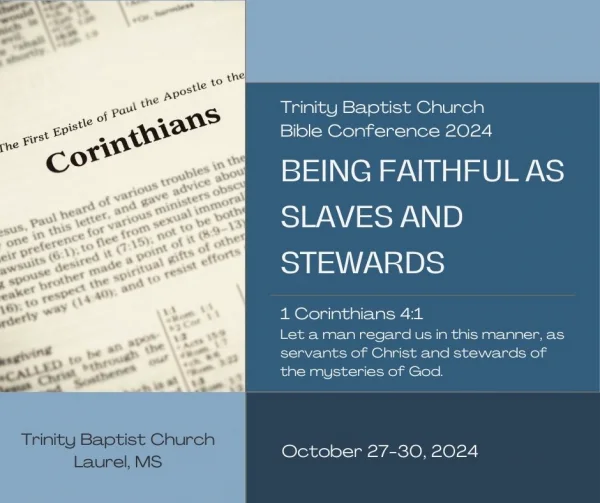
Trinity Baptist Church Bible Conference 2024 - Faithful as Slaves and Stewards
Faithful to the Open Door of Ministry

Acts 19
Sermon Study
The closing conference message calls the church to walk through the open door of ministry God has placed before it. It gathers the week's emphases on preaching the Word, small group ministry, Spirit-empowered service, and faithful stewardship.
Primary Scripture
- Acts 19
Mentioned Scripture
- Revelation 2
- Mark 1
- John 6
- Luke 1
- Acts 20
- Mark 16
- 1 Corinthians 1
- Acts 14
- 1 Corinthians 16
- 2 Corinthians 2
- Colossians 4
- Acts 1
- 1 Timothy 5
Transcript
Brother Lewis, if my wife could sing, I'd sing in church just like that. That was a blessing. It was a blessing. Oh, it was a blessing. Something that they were singing and something that Brother Lewis said reminded me of something. I've been preaching to the church, obviously. But let me just say something. If you've not been to Calvary, if you've not come to saving faith in Christ, why don't you come to Christ? You know, when I was preparing to come, my wife asked me, she said, "Are you going to preach your testimony?" I said, "No, I'm not. I have done that before.
I've gone and preached my testimony." She said, "No, I'm not." She said, "Why aren't you going to preach your testimony? There are people that need to hear about coming to faith in Christ." I said, "Well, that's not the way the Lord's laid it out." Well, I thought about that as He was sharing about Calvary and His going to Calvary. If you've not been to Calvary, please come to faith in Christ. By God's grace, when I was 20 years old, God brought me to faith and I've never been the same. If you've not been born again by the power and the spirit of God, repent of your sin. Come to Christ.
He'll cleanse you, forgive you, give you a new heart, a new life, make you a new creation, and give you a whole new life. I better stop. I'll preach the wrong sermon. Well, if you would, take your Bible. Go ahead and turn to the book of Revelation. Revelation chapter 3, we're going to be in verses 7 to 13. I was sharing with a couple of the young men on the front row there that I will not cover all of those verses, but all of those verses go together. Hearing the message, I will get us to turn back to chapter 1 as well. But if you're there at Revelation chapter 3, you'll be safe.
But I want to say thank you, Trinity Baptist Church, for having me. It has been a blessing. If you've been blessed, I've been blessed 10 times more. I want to say thank you, Brother Beale, for having me, inviting me. It's been a blessing to me and my wife. And you have revived me by allowing me to be here. And I want to say thank you, Brother Beale, for leading us. But I want to tell you that I reviewed Brother Beale Sunday morning. Right in the pastor's office, he made the comment that because Joseph couldn't be here, he was the B-Team. And I said, "Hold on a minute." I said, "I've been the B-Team all my life.
It doesn't matter what team you're on, if you're serving the Lord, that's all that matters." So he's just serving. Let me tell you, church, when you've got a church house full of people who will just serve, the work of the church will flourish. Brother Beale, you've blessed me. You're 18 material in my book. I appreciate it very much. But you have been a blessing to me. You've been a blessing to my wife. It has been an honor and a privilege to come and minister to you and preach God's Word to you like this. My wife was sad. She needed to go back to work. She took off so she could be here.
But this morning, she headed back to Jones County, and that's why she's not here with me. But Trinity Baptist, I want you to know that Brother Beale is my friend. He is my brother, and he is my partner in gospel ministry. And I feel like you have become my friend, and I've gotten to know a whole lot of brothers and sisters here at Trinity. And it has been good for me to be here, and I hope that I can take this back with me. I hope I can go back and preach in a new way and minister in a new way, feel the spirit and empower by the spirit. But I want to ask you to pray for us a couple of things.
Pray for us because tomorrow night we will be doing a big community outreach event, a trunk or treat in Brookhaven. It's kind of common for everybody to trick or treat downtown, and our church is right where all that starts. I share with our church we're in the corner of trick and treat. And so last year we had a big trunk or treat, and we know for a fact we ministered to about 1,200 to 1,500 children. And that doesn't include parents. And we had men kind of witnessing and a little bit of street preaching sharing the gospel. We provided porta johns and hand washing stations for the community there.
And we were able to just kind of be the hands and feet of Jesus. So pray for us. The rain forecast is looking better. So pray for us. And then pray for us as a church. Our church is growing. We need more nursery space. We need more children's space. We're growing slowly, little by little. And we rent a church facility, and that's a good situation. But I have cast vision to our people that one day in the Lord's time we want to have our own facility. But just pray for that. But we're doing good. And I'm thankful to share that with you. But we need to get into the message because we've got quite a bit to cover tonight.
We've got quite a bit to cover tonight. Now here before us we have the sixth of the seven letters to the seven churches in the book of Revelation. Now if you know much about these letters and these churches, you will know that we have a division and a digression. We have a division and a digression. The first three churches were in much better shape. Of the first three, of two of the first three were seriously flawed, but they had maintained their allegiance to the faith. They had not caved into the pressures and the assaults that they were facing. But the last four churches were much different.
Three of the last four were seriously flawed and much worse than the first three. These last churches had large numbers within them that had clearly caved into and embraced the very destructive pressures and influences that they faced. And a lot of those influences came from false teaching and false teachers. So that means that if we read and we study these churches from the first one, the church at Ephesus, to the last one, the church at Laodicea, we can see a division and we can see a digression. It's really a downward spiral. But I want to point out another division.
Of these seven churches there were two that did not receive any rebuke or any correction. Yes, two of the seven did not receive any correction or any rebuke. The first that did not receive a correction was the church at Smyrna. Actually, they were the fearful church at Smyrna because they were very poor and faced tribulation before. And Jesus told them that they had more tribulation to come. So our Lord called them not to be fearful. But then the second church that did not receive a correction was the church at Philadelphia. We will see that they were faithful in a faithful church because they were truly faithful.
They did face trouble in tribulation from the Jews and the pagan culture. But as we will see, they remain true. They remain steadfast, faithful. So our Lord called them to continue to be faithful. And tonight I want us to study the latter to the church at Philadelphia. We can't study it all. We're going to study part of it. But I want us to see that they truly were faithful and the fact that they had a wide open door of ministry before them. Now, before we get into our verses, I want to point out one thing that has to do with the background and the context. I really could tell you a lot about the city and the history of the city and such.
But I want to simply touch on the history and the founding of the church. And this is relevant to all that we've been looking at this week. Just like with some of these churches, we do not know much about this church except for what we see in the verses. We do not know how the church at Philadelphia was formed or who was responsible. But many scholars believe that the church came out of Paul's ministry in Ephesus. We know that we know from Acts 19 10 that the entire region was impacted as the gospel went out from Ephesus. Now, notice how important this piece of information is.
Personally, I believe that the church came out of the ministry of the church in Ephesus. Acts 19 10 says the entire region was impacted as the gospel went out from Ephesus. And to me, that emphasizes the importance of how Paul placed Timothy at the church in Ephesus as their pastor. Of all the things Paul called Timothy to do, he especially called him to preach the word. He already learned that. That is because Paul knew that the preaching of the word would straighten out the church at Ephesus. And he knew that that work could definitely affect those other churches. So with all of that in our mind, let's get to our verses.
Revelation chapter 3 verses 7 to 13. Excuse me. Into the angel of the church in Philadelphia, right. The words of the Holy One, the true one who has the key of David, who opens and no one will shut, who shuts and no one opens. I know your works. Some translations say deeds. Behold, I have set before you an open door, which no one is able to shut. I know that you have but little power and yet you have kept my word and have not denied my name. Behold, I will make those of the synagogue of Satan who say that they are Jews and are not, but lie. Behold, I will make them come and bow down before your feet and they will learn that I have loved you.
Because you have kept my word about patient endurance, I will keep you from the hour of trial that is coming on the whole world to try those who dwell on the earth. I am coming soon. Hold fast to what you have so that no one may seize your crown. The one who conquers, I will make him a pillar in the temple of God. Never shall he go out of it. And I will write on him the name of my God and the name of the city of my God, the New Jerusalem, which comes down from my God out of heaven in my own new name. Verse 13, he who has an ear letting hear what the spirit says to the churches. Now this is how we're going to approach these verses.
We're going to look at the communication that they received. That's from verse 7. We're going to see the commendation that they received. That's out of verses 8 to 10. Now I will give you the rest of the breakdown of my message, but we're not going to cover this tonight. I'll be honest with you. When I do this, it's like breaking my arm off. I just want to cover it all. But then we have before us in these verses the command that they received in verse 11. And last, the counsel they received out of verses 12 to 13. And I just don't have time for this. So what I'm going to do is leave this for Brother Bill to cover.
Leave this for Brother Bill to cover. So let's jump right in to the message. So number one, I want us to see their communication out of verse 7. Their communication. Now just like in every one of these letters, the Lord identifies himself to the readers. But let's look at some important details here. First, notice who received the letter. The verse says, "And unto the angel of the church of what? Philadelphia." Now question, who is this angel? In the original, this word angel literally means messenger, one who is sent, a messenger from God, which is what an angel is. But what does this mean in this letter?
The angel here in verse 7 is the messenger from God assigned to this church. This would be the pastor of the church who was called of God to pastor this church. A lot like we see or just like what we see with Timothy. Again, it's almost like all of the Bible fits together folks. But notice who else is receiving this letter. First, this letter was addressed to the church at Philadelphia. So that would have been the believers in this particular church. Second, this was written to the churches plural. Revelation 2.7, Revelation 2.11, Revelation 2.29, chapter 3 verse 6, and chapter 3 verse 22, mentioned the church is plural.
Verse 13, we read earlier says, "He that has an ear, let him hear what the spirit says unto the churches." That's the Holy Spirit. So we see that this letter was addressed first to the pastor of the church, to this specific church, and then to the other churches as well. Now, scholars tell us that we have right before us what's called a circular letter, which means that this letter would have been circulated among all of these churches. And notice, it's been circulated all the way down through church history to us. Now, what does that mean for us? I've just said it. We're a part of the circulation.
This letter is addressed to Trinity Baptist Church. This letter is addressed to Grace Life Church, Brookhaven. And more specifically, this letter and all of these letters are addressed to the angels of the church at Trinity Baptist Church, to the angel at the church at Grace Life Church, Brookhaven. So that means that this is, that it is my responsibility, this is Brother Bill's responsibility, to take what we see here with this letter to Philadelphia and all of these letters and apply these things to the churches that we are responsible for. Brother Bill, we have a responsibility here.
We cannot ignore our responsibility or run from our responsibility. I really don't know what's gotten into me, but I'm going to get political again. If I understand it right, on the Democratic ticket that's running for president, the vice president on the ticket is Tim Walts. One of the scandals with him that I saw was he was in the military, and somehow before he was deployed, he got out of that deployment. What did he do? He shirked his responsibility. He walked away from his responsibility. He ran from his responsibility. Now, I don't know where you, how it is with you, but where I come from, we would call that being a coward.
Bill, we can't be cowards. We got a responsibility. Okay? You know it and I know it. Now, at this point, we see a shift in the communication. We move from who this letter was addressed to to who was sending the letter. So first, he says that he is the Holy One. Now, this word "holy" refers to God's absolute holiness. This speaks to the fact that he is separate from everything man knows. He is completely separate from sin, sinfulness, and all of what we would call humanity and human weakness. He is holy, he is totally separate from sin, and perfect in character indeed in every way.
But notice the fact in the New Testament, the title of Holy One, this title is used as a title for the Messiah. We know that as Jesus. In Mark 1, 24, the demon-possessed man identified Jesus as the Holy One. In John 6, 69, Peter said that he believed in and followed the Holy One of God. So here we see that Jesus, the Holy One, He is the One writing this letter. And it is not just that He is holy and He is, but that He is God the Son, the Holy One, that is God the Son writing this letter. Think about all the letters that you may receive. Do you get a bunch of junk mail? I mean, we pitch it right in the trash, right?
But what would be the most important letter you could receive? Think about that. And who would that, who would be sending you that letter? Think about it. Think about who's sending this letter, the Holy One. But then second, He says that He is the true One. Now the meaning of this word true in the original, it means to be genuine or authentic, but it means more. In the world of untruth, Jesus is true. In every way, He is true. In fault and word, indeed, He is the perfect revelation of everything that is genuine, authentic, and true. So Jesus is holy and true. I thought about it like this.
If the doctor examined you and showed you that you were unhealthy, and He had truth to back up that claim, would you take notice? If you went to the doctor and He used that word cancer, that dreaded word cancer, and He showed you the tests and the numbers, and He proved to you, He had proved truth that you had cancer. Would you receive that diagnosis? Well, if the Holy One examines us and our churches, and if He shows us that we are spiritually sick, will we accept His diagnosis as truth? Third, He says that He is the promised Messiah. This phrase, "Key of David," this speaks of the office of the Messiah.
King David was the anointed ruler over God's people, Israel, and it was prophesied that the promised Messiah would come from His house, which means His bloodline. This was spoken of when the angel Gabriel came to Mary to announce that she would give birth in the Messiah. We see this in Luke 1, 31 to 33. So He says that He is the promised Messiah. Fourth, He says that He is the all-powerful One. Look at how He says this in verse 7. Go back and look at the verse.
"And to the angel of the church in Philadelphia write, 'The words of the Holy One, the true One, who has the key of David, who opens and no one will shut, who shuts and no one opens.'" Now, notice what we have here. When our Lord says that what He opens cannot be shut, and what He shuts, it cannot be opened. This speaks of the great power of Christ as Lord God over His church. Simply what Christ Jesus wills to do in His church and for His church, no person, no people, no thing can hinder that or stop Him. And notice, this expresses and highlights the omnipotence of Christ Jesus, our Lord.
So take a step back and let's notice what we have here. In verse 7, we have some powerful communication from Jesus to His pastor at His church and in His communication, He describes and reveals Himself as the Holy and true One, the promised Messiah of God and the Supreme Lord over His church. Last night, we saw from Acts 20, verse 28. I think last night I said it was chapter 2, but it's Acts 20, verse 28. We saw that Christ obtained the church with His own blood. Well, tonight we see from verse 7 that Christ Jesus is the Supreme Lord over the church.
And we see the same thing in Mark 16, 18, where Jesus says, "And I tell you that you are Peter, and on this rock I will build my church and notice, and the gates of hell shall not prevail against it." Now, how does this apply to us today? I believe that we know that our Lord is the Holy and true One. I think we got that. And I believe that we know that He is God's promised Messiah. I believe we got that. I don't believe we struggle with those facts. But, as I have said several times this week, I believe we need to be reminded, and reminded again, and reminded again that the church is His.
Christ Jesus is the Supreme Lord over His church, and the church does not belong to us. And the positions that we do have in His church that do, they don't belong to us either. Even the stapler on the desk at Brother Bill's office belongs to Christ. Even the paper in the copier in His office belongs to Christ. Even the positions of small group leaders in our church, those things belong to Christ. So we are obligated to do with His church what He says we should do, period. What a question. Who was this letter written to?
Look, church, I keep making strong application to me as pastor of Grace Life, Brooke Avon, and to Brother Bill as pastor of Trinity Baptist Church. I do that because our Lord expects the pastor to be the ones that will lead out as the "Hupereté" slaves and stewards of His church. In this letter, in all of these other letters were written to the churches, but they were personally addressed to the pastor, every one of them. Now notice the order of these things. It goes to the pastor, and then these churches had elders who governed with the pastor, then it went to the other leaders, and then the body.
You see, that's why I keep pointing at your pastor and me. But then next, number two, their commendation, verses 8 to 10, we see their commendation. Now if you examine this letter, it's just seven verses, you will notice that almost half of what was written is in the form of a commendation. Half of what Jesus wrote to this church was to commend them and brag on them for the good things that they were doing. There's a big lesson here. If I brag on you, Trinity Baptist Church, don't listen to me.
Brother Bill, if the denomination says you're doing a good job, or even your most respected mentor tells you that you're doing great, don't listen to that. Examine yourselves by the word of God and see if God tells you you're doing a good job. Do we need mentors? Yes. Do we need folks to come along and say you're doing a good job? Yes. But let's just make sure we get it straight from the Lord first and foremost. Now as we get into these verses, we will see that within this commendation, we can see certain observations about this congregation and promises made to them that correspond with their circumstances.
MacArthur, John MacArthur, breaks these verses down into realities and promises. I don't like that. So what I've done, I've taken that, I've borrowed that, and I've changed that, kind of made it my own. But let's read verses 8 to 10. Verses 8 to 10. He says, "I know your works. Behold, I have set before you an open door which no one is able to shut. I know that you have but little power or strength, and yet you've kept my word and have not denied my name. Behold, I will make those of the synagogue of Satan who say that they are Jews and are not but lie.
Behold, I will make them come out and bow down before your feet, and they will learn that I have loved you. Because you have kept my word about patient endurance, I will keep you from the hour of trial that is coming on the whole world to try those who dwell on the earth." Now let's take a look at this church. First, I want us to see our Lord says that they were weak. The King James Version says, "Little strength." Now we do not need to make a mistake here. This was not a correction but an observation, and it seems to be favorable. They had this wide open door of ministry because they had little power, little strength.
It is interesting, most commentators believe that this church was small in number and that they were of the lower class in the city. Therefore, they did not have much influence within the city itself. You may not realize it, but the Corinthian church was compromised more of the lower class. Paul says in 1 Corinthians 1, 26, "For consider your calling brothers, that there were not many wise according to the flesh, not many mighty, not many noble." So the believers in Philadelphia were weak, no matter if they were weak from their number or because of their position in society or both, they were weak. Brother Beale, do you ever feel weak? I do.
You know, it's a unique thing, pastoring, because in many ways you're alone. There's only one pastor in the church. See, when a pastor meets another pastor and they're light-minded, oh, I mean, God just puts them together. Their hearts are welded together quickly because pastors can battle loneliness. Nobody in here understands what a pastor goes through unless you've been one. But along with that loneliness, a lot of times will come this crippling weakness. Pray for your pastor there. Sometimes it'll be a crippling weakness. Well, that's good, Brother Beale, because we don't have much to offer but Christ and Christ crucified.
The Philippian church is a great example of a small, weak church. Oh, but a great one. But then second, our Lord says they kept His word. We see this in verse 8. Now, this is simple and obvious. As a church and as a people, they kept His word. And scholars tell us that the construction of the language here indicates that they kept His word not just in the easy times but in the difficult times as well. Simply, they kept His word consistently and continuously. So these believers were weak, but they were strong in that they kept God's word when it was easy and when it was not, in the good times and the bad times, consistently and continuously.
An old church there is a big lesson here, a vital lesson here. Our strength comes from keeping His word. Not in our number, not in the amount of money we have in the bank, not in the amount of the offering that Sunday. Our strength does not come from those things. God showed me that in a brutal way. I shared with you all that we were a church out in the country and we moved. There's nothing wrong with a country church. We didn't own the property. The building was in bad shape and there were many reasons why we moved. We didn't split, we didn't fight, we didn't divide. We moved geographically, reconstituted, renamed and all that good stuff.
But before we moved, we went through a series of divisions. It started off when the two matriarchs of the church, it was revealed that they were embezzling and misappropriating money. And then it turned into a group that thought I didn't handle it right. Well, if you don't know, you don't know. We had a loophole in the financial system. I was trying to get some men to kind of come help and that was slow in coming along. And in seminary, I was taught that the pastor never touches the checkbook. And then after that, we had another group that created some more problems. But let me show you how it happened.
Prior to the move, our church was growing in number. We were full. I mean, we had almost as many on Wednesday nights as Sunday night. But when I cast vision about moving, it was like flipping a switch. The embezzlement problem came out. And by the time we moved, we lost 35 to 40 percent of our people. Then we moved in March of 2020 right in the middle of COVID. You talk about feeling weak. We had gotten so down numerically and financially. The one man that was left that could write checks, I just would tell him which checks to write. Some of them we couldn't afford to write.
And lo and behold, my music minister who was an elder in the church, he looked at me and he said, "What we thought was our strength was our weakness." This pastor needed to hear that because, oh, I was low. Because I believed in those people. I trusted in those people. And I don't care what you do. The pastor steps up and there's a big hunk of the people gone, and they're not coming back. And they created all kind of problems. You're pretty weak, Brother Bill. And see, what God did was this. Those people were not our strength. They were our weakness. They were problematic. They were divisive. And they caused all kinds of problems.
And God revealed them for who they were. And they left. And see, what we thought was our strength was our weakness. And then what we thought was our weakness was our strength. You see? Look, church, don't ever, don't ever trust in what man says we're strong. Don't ever look to what man says we should be to be strong. Look to what God says. But then third, our Lord says that they did not deny His name. We see that in verse 8. This means that they were faced with the pressures and persecutions. Which could have led them to deny the name of Jesus. But they did not. And we know that they faced great external pressures.
Which could have led them to deny Christ. And from verse 9, we see that they faced pressures from the Jews of the city. Who did deny Christ. Therefore, these believers would have faced all kinds of pressures and temptations from them. So these weak believers were strong. Because they kept God's word and they did not deny the name of Jesus. And then fourth, our Lord says they persevered. Oh, look at verse 10. The New American uses the word perseverance. The King James says, "Because thou has kept the word of my patience." Now what is meant here is not obeying the word patiently. But obeying the word with endurance through good times and bad.
Through easy times and difficult. They persevered in their circumstances. And they persevered, but they did this patiently. Have you ever persevered, grumbling and complaining the whole time? I have. So these weak believers, but they were strong believers, kept his word and they did not deny his name. And they persevered patiently in the difficult circumstances. But notice what we have here in verses 8 to 10. We see a great description of this church and these believers. And before we get into the promises that we see here, let's make sure we pause and really take note of what we see here. This was a strong church. This was a healthy church.
This was a spiritually prosperous church. This was a church that our Lord could use. Now I know I have applied these things to some, but look at what we must see and accept here in their example. Our Lord shows us what true church strength looks like. It had nothing to do with how many were in the pew or how much money they had or anything else that we used to measure church strength. Simply Jesus said they were strong because they kept his word and they did not deny his name. And they persevered in the word and in these things in good times and in bad times with great patience. Some rhetorical questions.
Will you keep God's word when others do not? It's easy when the ones across the street don't keep it, but it's hard when those in the pew right next to you don't keep it. Will you keep God's word when you suffer? It's easy to keep God's word when you don't suffer. It's hard to keep God's word when you do suffer. Will you keep God's word if you were all alone and you suffer even from the hands of those you least expected? Some of those who rose up in division against me at one time seemed like my biggest supporters and they had no chapter in verse. I'm going to come back to that in a minute. They had no chapter in verse.
Now let's continue with this communication, this commendation, excuse me. And let's examine the promises our Lord made to this church. Here we see three. First he promised that they had an open door ministry. We see that in verse 8. Notice this was an earned opportunity for service for the Lord. Now it was grace because it came from God, but notice what I'm showing you. They had been faithful to him, as we've seen. So he was being faithful to them by giving them an opportunity, which is an open door ministry. Now there's something important that we need to see here. The idea of an open door was often used by Paul.
As a matter of fact, we see Paul use this kind of language four times. In Acts 14, 27, 1 Corinthians 16, 9, 2 Corinthians 2, 12, Colossians 4, 3. As Paul was writing to the Colossian Christians, he said in chapter 4 verses 3 to 4, "At the same time, pray also for us that God may open to us a door for the word, to declare the mystery of Christ on account of which I'm in prison, that I may make it clear which is how I ought to speak." So make sure you see this because of their faithfulness and Christ's grace and faithfulness to them. Our Lord promised them an open door of ministry. Now to me, we see a principle here.
Faithfulness begets opportunity. Of course, this is all according to God's will for his people and God's grace. He's the Lord over his church now, but faithfulness often begets opportunity. Now I am not God, but look, church, look, Brother Bill, if you are faithful to God's word in the name of Jesus, and if you persevere in the word and in his name in good times and bad times, I believe that God will open up opportunities for you. He has for us. Second, he promised them that they will have vindication from their enemies in verse 9. Now this difficulty with the Jews was a problem for the Christians in Smyrna.
They faced this as well, but notice the Christians at Philadelphia were able to enjoy something. The Christians in Smyrna could not. In verse 9, Jesus promises that these Jews would come and bow at their feet. Now what does that mean? Now understanding this phrase before your feet is key to understanding what's going on here. And the King James helps us here. The King James says, uses the word worship. But the word rendered worship here in the original, it means to be fully prostrate and to do homage or to worship in a proper sense. And as was commonly done in their day by falling out on your face.
And for this situation, this may refer either to spiritual homage, that is the worship of God, or it may mean respect as shown to superiors. So this leads to a question. Does this mean that these Jews would have been converted? Well, we really don't know. I gave us a good example. In the book of Ezra chapter 1, we see that God used King Cyrus of Persia to release his people from captivity. This was a pagan king, and he was used of God to bring about God's plan for his people. So God certainly could have used pagan people in this circumstance for his purposes.
But here we see that our Lord promised them vindication in the face of their enemies. Third, he promised them that they would be spared a test, a tribulation in verse 10. Now this verse is hotly debated, as well as others that relate to this subject in verse. This verse refers to the debate over the rapture of the church. This argument is around whether or not the church will go through the tribulation or be raptured before the tribulation. Now I will be very, very basic here. Simply, there are three views of the rapture and the timing of the rapture. The first view is the pre-tribulation rapture of the church.
I know you know this because of your pastor's teaching. This view says that the church will be taken up before the rapture, but they will be taken up or raptured before the tribulation. The second view is a mid-tribulation, and then there's a post-tribulation view. And those are different views in how people see the rapture of the church. Now we need to examine the language here to get a little insight, but I want to give a disclaimer here. First, me and a lot smarter than me have been debating this for years. Brother Bill and I have had this kind of discussion. We could get a lot deeper here, but I will save that for your pastor.
And I know he's taught you thoroughly here. But then third, this is not a deal breaker issue. If we do not all see the end times just the same, we can't divide over those things. But let's notice the specifics in verse 10. I'll be real quick here. Notice the testing or tribulation. The New American says, "hour of testing." The meaning of this word is a time of testing or trial, which could lead to temptation. So we need to see that there is the time of testing, which is in the future and for a certain amount of time. And we need to see that there is a time of testing, a time of examining. This word means to test or to place one under trial.
Also, there is the time to examine all. The English Standard says the whole world in this world, this word world, it means inhabited earth. But then notice the protection. This word keep from is at the center of the debate here. Those who believe that the church will go through the tribulation, the time of testing, understand this to mean a preservation in the middle of and coming through. Those who believe that the church will be taken before the tribulation, understands this to mean from or out of. And I think we can see that there are lots of different ways we can view these things. But I know Brother Bill has taught you well here.
And honestly, I view these things very similar, if not just like Brother Bill. But notice these promises made by our Lord to his church. He promised them that they had an open door of ministry and no one or no thing could close it. And he promised them that they would be vindicated before their enemies. And he promised them that he would spare them from the great trial that was to come. Now church, there are some really, really important things we need to see here. So let's perk up. First, no matter your view of the end times, or no matter if you've not gotten those things straight in your head.
Remember this fact, God will take care of his church. God will take care of his people. It does not matter who wins the election or what happens in the Middle East. Jesus is Lord over his church. And he will finish what he started when he purchased the church with his own blood. He will take care of his church and his people. I know Brother Bill, and I mentioned one of our men, Tommy, who visited with us a couple of nights. He approaches these things ultimately and finally by looking at Acts 1, 7, 8. There the disciples asked Jesus about the end times.
And Jesus told them that that was not for them to know, but that they would go fulfill the great commission. And what Brother Tommy does is this. He may study the end times, but ultimately he says, "I can't know all these things. I've got to be busy preaching the gospel." But second, God can vindicate you before your enemies. He can. He may. He may not. He may bring our enemies to bow down to us. Or he may allow our enemies to persecute us and kill us. But no matter what, we should love God and serve God. And the lesson here is this. Just let God take care of the enemies.
We should just keep our head down, living for the Lord, and let God take care of our enemies, however He chooses. But the third lesson comes in the form of a question. But don't answer these questions quickly. My wife pointed something out last night, Brother Bill. When I preach, I ask rhetorical questions. And my wife said, "You better be careful with those rhetorical questions. The folks at Trinity answer them." I didn't bother me. But some questions. But think before you answer. Have you kept His Word? Have you stayed true to the name of Jesus? Have you persevered patiently in keeping His Word and staying true to the name of Jesus?
When it has been easy, when it has been tough in good times and in bad times, you see, Church, the key. The key to the open door of ministry is keeping His Word and remaining true to the name of Jesus and doing these things with great patience and endurance, even when we face trials and troubles. Think about that. Now, at this point, I want to start. I'd rather not. But because of time and some other things I want to share, I'm going to leave the command in verse 11. Basically, the command was this. Hold on to what you have. And then I'm going to leave forth their counsel out of verses 12 to 13.
And that's where He says, "He who has an ear, let him hear." But at this point, I want to offer five points of observation and instruction to close the message in really our time together. And this all comes out of some verses here in Revelation. I mentioned these seven churches earlier. Here in Revelation, chapter 1 to 3, we have seven churches. Church at Ephesus, Church at Smyrna, the Church at Pergamum, the Church at Thyatira, the Church at Sardis, the Church at Philadelphia, and the Church at Laodicea. But I want us to see what these churches were. So, number one, they were lampstand churches with our Lord walking among them.
Would you please turn to Revelation, chapter 1? Here we see the beginning of the letter. John was in the Spirit on the Lord's day. The Lord began to unfold all these things to Him and for Him. He told Him to write them down. I'm going to pick up with verse 12. He had heard a voice. It says, "Then I turned to see the voice that was speaking to me, and on turning I saw seven golden lampstands, and in the midst of the lampstands one like the Son of Man." And then there's a description. It says in verse 17, "When I saw Him, I felt at His feet as though dead." You can answer this one. Do you all know who He was? Jesus.
"And when I saw Jesus, I felt at His feet as though dead, but He laid His right hand on me, saying, 'Fear not, I am the first and the last, and the living one. I died, and behold, I am alive forevermore, and I have the keys of death and Hades, right therefore the things that you have seen, those that are and those that are to take place after this. As for the mystery of the seven stars that you saw in my right hand and the seven golden lampstands, the seven stars are the angels of the churches and the seven lampstands are the seven churches." Now what we see here is this. These were lampstand churches. The lampstand symbolized the church.
But notice, our living Lord Jesus was walking among them. And look, Trinity, ponder this, Brother Bill. If Jesus saw the church at Thyatira as a lampstand church, then He certainly sees Trinity Baptist and Grace Life Brookhaven as lampstand churches. You know the problem with the church at Thyatira. They had an evil woman Jezebel teacher in the church, leading people into immorality. And if the Lord Jesus saw the church at Thyatira as a lampstand church, then He certainly sees our churches as lampstand churches. And the point I'm making here is this.
The living Lord who is Lord over His church is walking among us, walking among us, walking among us. That ought to scare the socks off of us. That ought to sober us up and tighten us up. Number two, these angels, these pastors, these pastor teachers who are in the right hand of our Lord, look back at the verses. "Then I turned to see the voice who was speaking to me, and on turning I saw seven lampstands, and in the midst of the lampstands one liked the Son of Man. And then when we continue to read the verses, what do we see? We see that the angels were in His right hand. Now what we see here is this.
These were angels, they were pastors, and they were in the right hand of the living Lord who is Lord over His church. And look, Brother Bill, look, Trinity Baptist, if Jesus held in His right hand the pastor of the church at Thyatira, who allowed a woman Jezebel teacher in the church, who led people into sexual immorality, then He holds you, Brother Bill, He holds me in His right hand. And look, Bill, if we are in His right hand, and we are, then we have no right to pastor like the world says or a man says, and we should fear no man. Brother Bill, if you're in His right hand, who can get you?
And look, Trinity Baptist, if your pastor is in the right hand of Jesus, you better be very careful how you treat Him. It's a very dangerous thing to undermine and to attack a pastor who is in the right hand of Jesus. But I want you to see this with balance. I'm not exalting Brother Bill or myself like we're the Pope, untouchable. Brother Bill is a big sinner too, so that means he needs God and leaders around him. If you study the New Testament, you'll see that lead pastors, pastor teachers like Timothy had other elders around them. So Brother Bill needs Godly leaders around him. I've got Godly men around me.
I'm not elevated like I'm the boss man of the church. And there is a biblical process for dealing with a pastor who is in some kind of a sin to purify him and to correct him. Now I'm not asking you to turn here, but you need to write this verse down in 1 Timothy 5.19. Let me back up to verse 17. We read this last night. "Let the elders who rule well be considered worthy of double honor, especially those who labor in preaching and teaching.
For the scripture says, 'You shall not muzzle an ox while it treads out the grain.' The laborer deserves his wages." But now notice verse 19, "Do not admit a charge against an elder." Brother Bill is a biblical elder. Those terms in the New Testament, elder, overseer, pastor, shepherd, those are synonymous for one office. Verse 19, "Do not admit a charge against an elder except on the evidence of two or three witnesses." And look, if you see Brother Bill in sin, you go to other leaders, go to other deacons with that, and you follow the scripture here.
And if Brother Bill's a man of God, and three or four deacons come and they say, "We see something in your life that's not right. He should submit to that." You see it? I have a pastor friend who has a body of elders around him as a pastor. He told the story of one night he went into an elders meeting, and they had a piece of paper, a piece of paper with things that they saw in his life that they were worried about, some little attitudes, some things he'd say. And they looked at him in tears and said, "We love you. We don't want these things to be a hindrance to you or to the work of the church." You know what he said?
He said, "As soon as he saw it, he got mad." Well, then about two seconds later, he started to repent. You see how it works? But what am I trying to show you? You be careful with your pastor who is the right hand of Jesus. Then number three, we have seen this all week, and right here we see this again. It is the pastor's job to take the Word and then to apply it to the Lord's church. It is the pastor's job to find out what God's Word says about his church and what the church should be and do, and then straighten out the church accordingly in all of these letters. Who were they addressed to?
They were addressed to the pastor, and then that was meant to go down to the other leaders. But then number four, this is serious business. Let me show you how serious this is. Look at Revelation 2. We see probably above verse 1, there's a heading in your Bible that says to the church at Ephesus. And then verse 1 it says to the angel of the church at Ephesus, right. But notice what verse 5 says, "But I have this against you," verse 4, "that you have abandoned the love you had at first. Remember therefore from where you have fallen, repent to do the works you did at first.
If not, I will come to you and remove your lampstand from its place if you do not repent." Those are serious words. Then chapter 2 verse 16, we see this is the letter to the church of Pergamum. "Therefore repent. If not, I will come to you soon in war or fight against you with the sword of my bow." Two circumstances. Jesus says, "If you do not do what I say, I will remove your lampstand or I will come fight against you with my word." This is serious business, folks. And look, church, this is serious business being a whoop or ate a slave and stewards and managers who are responsible of Christ's church.
And we must see that there are very serious consequences for deliberately not managing our Lord's church according to His word and His expectations. And then number 5, I am certain that you do have an open door before you. I'm going to repeat that. I am certain that you do have an open door before you. Think about it. We know that the church at Philadelphia had an open door before them. But think about it, Brother Beale. If all these churches had led their churches to obey what our Lord commanded them, did they not have an open door as well? Did our Lord command the Ephesian pastor to lead that church back to their love for Christ?
For Jesus to only slam the door shut? No. And look, Trinity Baptist, look, leaders, look, Brother Beale, you have an open door of ministry before you. And it will require you being true to the name of Jesus, obeying and keeping His word. And if you are disobedient, then you need to obey God's word and keep it. And you are required to do these things with great patience and perseverance. And my challenge for you, Brother Beale, is this. Go through the door. Lead Christ's church through the open door. Shepherd the flock of God among you by leading His sheep and the church through the open door.
And then men, older men, younger men, get behind your pastor. Get behind your pastor. Tell him you love him. Tell him you support him and support him. Tell him that you want him and expect him to lead the church through the open door that God has put before you. Church, the church always should move forward. The door isn't there to stand there and look at. It's open to go through. So my question for you is this. Will you be faithful to the open door of ministry before you? And being faithful to preach the word. And being faithful to small group ministry. Being faithful to the filling of the spirit and the empowerment of the spirit.
And being faithful as slaves and stewards. If you are Hooper-Rayte slaves and good stewards of the gospel in his church, we will, you will, we always will be faithful to the open door of ministry before us. All for the glory of God. simply because he deserves it.