Jesus - The Divine Word

John 1
Sermon Study
John 1:1-5 declares Jesus to be the divine Word who was with God, was God, and gives life and light. The sermon calls the church to see Christmas through the glory of Christ's eternal deity.
Primary Scripture
- John 1
Mentioned Scripture
- Romans 5
- Genesis 1
- Genesis 2
- Genesis 3
- Matthew 8
Transcript
Well if you would take your Bible and turn back to John, the Gospel of John chapter 1. Just like I said in our scripture reading will be in verses 1 to 5. Now I will reference some other scripture and I'm gonna ask you to note a couple of portions of scripture and make that a part of your reading during this Christmas season. I'll tell you what those portions of scripture are here in just a minute. Now I think that most of us know that Thanksgiving is behind us. I thought about it like this. Thanksgiving may be in front of us. You can figure that one out.
But Thanksgiving is behind us and the Christmas holiday, the Christmas season is right in front of us. Now I don't know about your house, but we have already been getting ready for Christmas. Gifts have been arriving at the house. My wife has been putting out all of the Christmas decorations and to be honest with you, I did something this past week that I have never done in our 28 years of marriage. I went to Home Depot and I picked out the Christmas tree all by myself. Now I was instructed to do that. I didn't do that on my own.
I saw some ladies make some faces like, "Pastor, did you have permission?" Now I'll be honest with you, I was nervous. I felt like I could pick the wrong one, but I'm not bragging, but I picked out the best one. She was happy. If she was happy, then I am happy. But for me and getting ready for Christmas besides picking out a Christmas tree and doing what my wife needs me to do to get ready, I have been studying what the scriptures say about Christmas. And I was reminded of what Christmas is all about Friday night.
Christy was putting the last of the decorations on the tree and she showed me a small nativity scene that we've had on our tree for years. Now let me test your knowledge here. Do you know what or who is in a traditional nativity scene? Think about that. Usually we see angels or some representation of angels. Usually we see the shepherds. Usually we see the magi. Usually they're called the wise men. Usually we see certain animals there in the nativity scene because Jesus was actually born in what we would call a barn. Of course we see Mary and Joseph, but in the center of a nativity scene, we have baby Jesus.
You might say, "Pastor, that is obvious." But I'm not gonna ask you to turn to these two portions of scripture, but if you look at Luke's account, his gospel account, you will see the nativity scene. You'll see that in verses one to 20 of Luke chapter two. Note that, I would like you to go study that on your own. Luke chapter two verses one to 20, we have a very full account of those events and what I would call the nativity scene. And then Matthew's account, we see that in Matthew chapter two verses one to 12, and he gives a shorter account. But notice something if you know those verses.
A traditional nativity scene usually has all the nativity, I call them individuals, they're at the birth of Jesus. But that was not the case according to the scripture. The wise men came after Jesus was born. And you'll see that when you study Matthew chapter two. But no matter if we are reading Luke's account of the nativity or if we are looking at a nativity scene that we are accustomed to seeing, Jesus is at the center of things. Isn't that right? The baby Jesus is at the center of the nativity. And look church, that is what Christmas is all about.
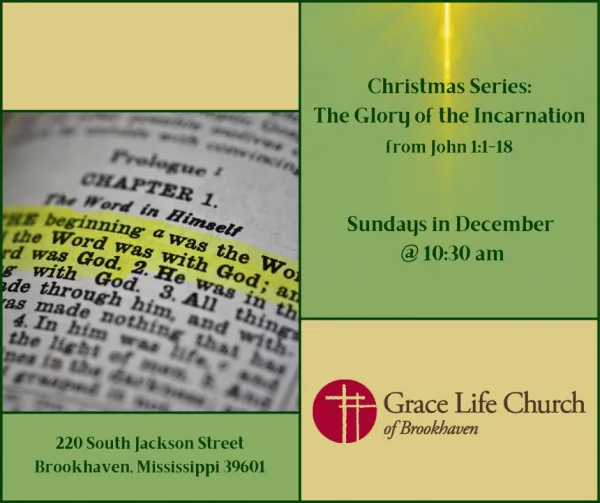
So this morning and until Christmas, I want us to study what I call the glory of the incarnation. That's the title of the series, these messages. The glory of the incarnation and that is from John chapter one verses one to 18. Now this is what these 18 verses are all about. John shows us three things about God the son being born as a baby, that is the incarnation. From verses one to five, John presents Jesus as the divine word. From verses six to 13, he shows us the response of the word coming into the world. And then from verses 14 to 18, he shows us the glory of the word becoming a man.
So this morning, we're gonna look at verses one to five and what I'm calling Jesus, the divine word. Now before we get into our verses, I wanna point out a few things about John chapter one. And this will help us see the magnitude, the magnitude of what's before us in these verses. Here in John one, we have the deepest, most profound truths in the universe in the clearest form.
We have the deepest, most profound truths in the universe explained in such a way that the brightest of minds and all humanity cannot begin to comprehend these things, but at the same time, even the simplest of minds who believe these things by faith, can grasp these things. But what makes this chapter so great? Among all of the other teaching of the Bible. Here in chapter one, we have some of the clearest, the most profound truth concerning the incarnation and the great glory of the incarnation. Well, we need to ask and answer the question, what is the incarnation?
The incarnation was and is the act of the Son of God, whereby he took upon himself a human nature and flesh and became a man. And when he became a man, he was fully God in every way, except sin, and at the same time, he was fully God and never ceased to be God. Simply, the incarnation is when God the Son became a man, therefore he became the God-man. Sometimes you will hear people say that he was 100% God and 100% man, that is not necessarily wrong, but that can imply that he can be less than. A better way to say it is this, he was fully God and fully man. So that is what John chapter one is all about.
Now, I have already said that we'll be looking at verses one to five this morning, and what I call Jesus, the divine word. And out of these five verses, we will see Jesus as three things. First, the preexistent word. Second, the all-powerful creator. And third, the self-existent one. And then I will show us how this relates to our Christmas, our Christmas holiday, and I'm gonna give us some challenges, some instruction that I think we all need. So let's get started in the message. Number one, or the first major truth in our outline, I want us to see Jesus, the preexistent word. Jesus, the preexistent word, we see that in verses one to two.
Let's read the verses again. John says, "In the beginning was the word, "and the word was with God, and the word was God. "He was in the beginning with God." Now, when we see these first words in the beginning, we may think of the first words of the book of Genesis, Genesis chapter one, verse one. "In the beginning, God created the heavens and the earth." Now, although John is using the very same language, John was not writing of the beginning of the creation of Jesus, because Jesus was never created because he was and is God. But John was writing of his preexistence. Simply, Genesis one starts off by speaking of God's first creation.
But John one starts off by speaking of the preexistent one, the eternal one, the one who was there in the beginning when God created the heavens and the earth, as seen in Genesis one too. But let's look at what John speaks of as he describes Jesus as the preexistent word. First notice that John spoke of time. Notice that two times, John uses this phrase in the beginning. We see that in all the translations we reference. In this word for beginning, in the original, it can have several meanings. It can speak of a source, an origin, but it can also speak of rule, ruler, or one in authority. So what John was doing and saying here is this.
He was referring back to the beginning of the creation that is spoken of in Genesis one, one, but even more, even further back. He was actually going back before the creation, that is as we will see, he was speaking of time as it relates to Jesus as the preexistent one. So he, John, was speaking of a time before time began in the creation. Bible scholar A.W. Pink says, and I'm quoting, "John one, one precedes the making of all things "of Genesis one, three." But then second, John here, he spoke of the word. Notice that three times John uses the phrase the word. We see that in all the translations we study.
In this word in the original, logos, it meant something to both the Greek audience and the Jewish audience of this original letter. To the Greeks, who were in the philosophy, education, and the high thinking, they had an idea of some kind of a creative force behind the universe. But in their thinking, this creative force was impersonal. But they believed that within this creative force was a source of wisdom. And that is what they were searching for in their high learning, in their education, and in their philosophy. So they used this very word, logos, to describe this creative force. But then to the Jews.
They had a use for this word as well. They used this word logos all throughout the Old Testament as it was used to refer to the Lord. So they used this word to speak of God. So that means that when these readers of this book heard this word logos, that really got their attention, both Greeks and Jews. But then third, John spoke of where the word was. Notice that the text says, in the beginning was the word and the word was with God. Here John is adding another layer to what he is saying. He said that this word, this logos was with God. And scholars tell us that in the original language, it paints a very vivid picture that we need to see.
And I'll get us some help here. John MacArthur says, "That phrase means "far more than merely that the word existed with God. "It gives the picture of two personal beings "facing one another and engaging in intelligent discourse." The scholar Vincent in his famous word study says it this way, and I'm quoting, "John's statement is that the divine word "not only abode with the Father from all eternity, "but he was in the living, active relation "of communion with him." But then fourth, John said who the word was. Notice that the text says, in the beginning was the word and the word was with God and the word was God.
Now we must not overlook this part of the verse because this is extremely important in our understanding of who Jesus was and is. And if we get this wrong, this is where we jump off into the pit of horrible heresy. So right here I wanna point out a few facts. First, there are some that argue that because of the language used with God, that this is not God, but somehow less than God, even someone with God-like qualities. But that's wrong because the language says the word was God. But then second, although the subject here in the phrase is the word, the emphasis in the language and the construction of the language is God.
This is where the amplified helps. It's very accurate. The amplified says, and the word was God himself. See the emphasis? And then third, the language simply does not identify the person of the word. That is just a wrong idea. And there's some that believe that. Now what is my point here? And why do I take the time to point out those fallacies? If we do not handle the language here properly, again, we jump off into the pit of heresy. I give you an example. The Jehovah's Witnesses in their faulty, demonic New World Translation, they mistranslate this verse.
In their faulty, demonic translation, John 1.1 says, "In the beginning, the word was, "and the word was with God, and the word was a God." They get it wrong. And for the original recipients of this letter, this was critically important. This was life and death because there were all sorts of heresies that were attacking the person of Christ in their day, just like today. So John was explaining and defending what we would call a proper Christology. And a proper Christology simply speaks to the proper doctrine of Christ. But then fifth, he said the word was God. Now the New American, the English standards say the same thing.
He was in the beginning with God. And here John tells us who this word was and is. And simply, this is Jesus. And if you pay attention, you will see that this is really a repeat of verse one. But John certainly reveals who this word was and is, and that is Jesus. And notice what John was and is revealing and saying. Jesus was and is preexistent. He was with God and he is God. Now listen to verses one and two in the Amplified. The Amplified reads, "In the beginning before all time "was the word Christ and the word was with God "and the word was God himself.
"He was continually existing in the beginning "co-eternally with God." The Amplified really nails it. Now notice what we have here. Theologically, this is proper Christology. And that term really means the proper doctrine of the person of Christ. And this is proper Christology 101. And this is life and death. Because again, if we miss this, if we get these verses wrong, we jump off into the pit of heresy and we lose the faith. Also, here we have some vital teaching concerning the Trinity. Yes, the doctrine of the Trinity. Here we simply see God the Father and God the Son. It's plain.
Of course, we do not have any mention of God the Holy Spirit, but John does teach on the person of the Holy Spirit later on in his book. But notice how this should relate to us at Christmas. Yes, we know that the baby Jesus was and is at the center of Christmas. Christmas is all about God the Son becoming a man. But we must see, we must understand, and we must never forget that that baby that was in the manger was and is the pre-existent word. You see that? We must never forget. We must always hold onto the fact that that baby Jesus that was in a manger was in fact the pre-existent word. Now, a question.
How can we make these facts, these deep things, how can we make these things the center of our Christmas? First, by reading and studying these scriptures, by reading and studying this message, by reading and studying other scripture that relate to these things. And then reading and studying and meditating on these things whereby these things become a part of our thinking and our understanding. They're just in our bones. I give you another way we can make these things the center of our Christmas. There is good music, Christian music, that sing of these things. Some of the sovereign grace music that we sing sing of these things.
Some of the old hymns of the faith sing of these things. And you may not be able to carry a tune in a bucket, but you can listen to those things and let those truths resonate in your heart and mind and in the walls of your homes. You can talk about these things with your spouse in your home. And parents, I would encourage you to teach these things. You can get my notes, you can get these scriptures, and you can teach your children these things, and you should. And you can pray these things back to God. Have you ever prayed truth back to God?
When you pray truth back to God, the Holy Spirit of God will take that truth and it will resonate in your heart and your mind and the picture will become brighter, the light will become brighter, your heart will become warmer towards God in these things. Let me continue. Number two, John shows us that Jesus is the all-powerful creator. Here we see in verse three that Jesus is the all-powerful creator. Look at verse three. It's real simple.
John says, "All things were made through him, "and without him was not anything made that was made." Now, if we pay attention to all of our verses, we can see that John speaks of God the Father and God the Son. I've already stated that. In verse one, he speaks of God the Father at the end of the verse. But here in verse three, he speaks of God the Son, and we know that this is God the Son because verse two tells us. Let's go back and read all of the verses and you'll see what I mean. In the beginning was the Word, and the Word was with God, that's God the Father, and the Word was God, that's God the Son.
He, that's God the Son, was in the beginning with God, God the Father, and notice, "All things were made through him, "and without him was not anything made that was made." But notice what we see here in verse three. John does not say that God created all things, but that the Son created all things. Now, let me explain all of these things. First, John says that Christ created. Now, the English Standard Version says, "All things were made through him." The New American says, "All things came into being by him." And in the original, this literally means, "Came into being or became," but notice this by him or through him.
This refers to Christ, but there is more, so follow me. The language of verse one describes a state of being. Notice, "In the beginning was the Word, "and the Word was with God, and the Word was God." That is a state of being. But the language of verse three describes action. The verse says, "All things were made through him." See the action? So in verse one, Christ Jesus is the pre-existent, continual being. He was and is God. But in verse three, Jesus Christ is the all-powerful creator God, "All things were made by him and through him." But then second, John says that Christ created all things.
Now, in every translation I reference, it reads, "All things and all means all." And this is simple. This is referring to not just all the creation, but to every detail of the creation. Christ created all of the universe broadly, but Christ also created all of the universe in every detail. And then third, John says that only Christ created all things. In the first portion of the verse, John is positive. But to emphasize what he was and is declaring, notice that John changed and he changed to a negative tone. Look back at verse three. "All things were made through him," that's the positive. And now notice the same thing in the negative.
"And without him was not anything made that was made." This word, nothing here, we see this in the New American Standard. In the original, it literally means not even one thing, but there is more. This has come into being in the New American or that was made in the English Standard Version. In the original language, this is in the perfect tense, which means there is a continuance of the created. That which was created is continuing. That which was made, that still exists because it was made by him. We can say it like this, it is sustained by him. So notice what this emphasis in the second part of the verse three is saying.
In using negative language, John is emphasizing that only Christ created. The Bible scholar, D.A. Carson says that this can be translated, all things were made by him and what was made was in no way made without him. And also this present tense language indicates a continual creation. Not that he was and is continuing to create, no. But that was made is continuing to exist. Now in case you need a little more convincing here or in case you need a little more light here, let me give you some more scriptural evidence that Christ was and is the creator just as John says.
Paul says in Colossians one verses 16 to 17, for by him all things were created both in heaven and on earth, visible and invisible, whether thrones or dominions or rulers or authorities, all things have been created by him and for him. Now notice by him, that is Christ, and all things were created by him and for him. And notice all things have been in earth, unseen and seen, powers, rulers, all things. We also see this in the Old Testament. In Genesis one verse 26, in Genesis chapter three verse 22, in the original Hebrew language in which these things were written was pluralistic language.
Clearly God was and is speaking to someone and that someone was and is Christ the living word. Now did Moses see this as God the Father and God the Son? No, but we have a complete revelation whereby Moses did not. So notice John, Paul, in Genesis one and three tell us the very same thing. And again, listen to verse three in the Amplified. It reads, all things were made and came into existence through him and without him, not even one thing was made that has come into being. I like what A.W.
Pink says here and I'm quoting, just as he was before all things and therefore eternal, so was he, was the originator of all things and therefore omnipotent. In other words, being God. And again, notice what we have here folks. Theologically this all relates to proper Christology, understanding the person of Christ. But at this time of the year, as we celebrate Christmas, we must see and understand and never forget, it must be in our minds that that baby Jesus who was literally born in the form of a baby placed in that manger at that very time and he will steal the all powerful creator God.
Now how do we make these facts and these things the center of our Christmas? We read these verses, we study over the message, we study other scripture that relate to these things, we meditate over these things so that they will be a part of our thinking and in our conversation and a part of our life. Again, we sing of these things. We listen to music that explains these things. We talk about these things in our home with our spouse. Parents, we should teach our children these things and we can get you information and my notes to help you.
And we pray these things back to God in such a way that it is in our mind and in our thinking and if a brother or a sister asks us, we can parrot these things in our own words back to them. But then, number three, John shows us that Jesus is the self-existent one. We see this in verses four to five. John shows us that Jesus is the self-existent one. Now we have already seen that John presented Jesus as the pre-existent word and the all powerful creator. Now he presents Jesus as the self-existent one and notice that he uses the language of light and life, life and light. Let's look at the verses, verses four to five.
In him was life and the life was the light of men. The light shines in the darkness and the darkness has not overcome it. Now here, I want us to see that John points out four things about Jesus which tell us that he was and is the self-existent one. First, he says that Jesus is life. Now all the translations that we study say the same thing but here we must see that John speaks of God's very nature. He says that within Christ who is God, according to the second part of verse one, we see God's very nature which is life. Now notice something here. We already know that all life came from Christ.
That is because verse three tells us that all life was created by him. The scholar Vincent says, and I'm quoting, "He, thus Jesus, was the fountain of life." And he goes on to say, "Physical, moral and eternal life." And in the original language, this word translated life, it is used for spiritual or eternal life. So right here, I want to borrow what Vincent says. Notice Christ is the fountain of physical life. We see that in Genesis chapter one and chapter two at the creation because he created all physical life. Notice that Christ is the fountain of moral life. We see that in Genesis one and two as well.
When Christ created Adam and Eve and he created them morally perfect. And notice that Christ is the fountain of eternal life. That is what John one four tells us. So Jesus is the source. He is the fountain of physical life, moral life, but also eternal life. And that tells us that in his very nature, Christ Jesus is life. Contrast that with man and man. By nature, man and men and mankind is in death. Romans 5, 12 says, "Therefore, just as sin entered into the world through one man, who is that one man, Adam?
And death through sin, so death spread to all men because all sinned." So by their very nature, the lost man, the man who is not in a saving relationship with Christ, that man is in death and by his very nature, they are truly death. But by his very nature, Jesus is life. Physical life, moral life, and eternal life, and physical and moral and eternal life emanate from him because he is the fountain of all of those things. And then second, he says that Jesus is light. Again, all the translations say the same thing. But notice how John moves from life to light. But we must see that the two cannot be separated.
This life and light cannot be separated. Notice that Jesus is physical light. Genesis 1 tells us that he created the light. And notice that Jesus is spiritual light. We see this in John 1, 4, the verses that are before us. And this light is a manifestation of life. Life and light cannot be separated just like God and Christ cannot be separated. God the Father, Jesus the Son, the Word and eternal life are all inseparable and light is a manifestation of life. We see this in the Garden of Eden with Adam and Eve. God was their life and their light according to Genesis 2, 7 and Genesis 2, verse 15 to 17.
God created them, God cared for them, God gave them a purpose, God gave them instruction, God gave them life and God himself was the light and life that they possessed. But in Genesis 3, 8, we see that their fellowship was broken because of their sin and rebellion. And we see this in the incarnation. When Christ came into the world and to men and to mankind, he was the light of men. Then it says here, the word becomes light through the medium of life. But then third, John says that Jesus shines in the darkness. Again, the translations all say the same thing, but notice a shift here.
Here we are moving from who Christ is, he is life and he is light. And here we're moving into what he does. Notice the light shines. In the original, it is in the present tense. This means that the light of Christ Jesus has gone out continuously and still goes out. That means that Christ Jesus went out and is still going out to this very day. And notice the light shines in darkness. It is interesting to see, but this word darkness here that John uses in the original, it's a very odd word. And scholars tell us that in the classical Greek language of the day, the word for darkness that is used here in the verse is stronger.
It is the strongest used compared to anywhere else. So notice what John is doing. He used the strongest word for darkness. And this darkness represents sin and rebellion against God. And this was and is a very deep and dark sin and rebellion. John uses the hardest of words for darkness. Then fourth, John says that the darkness did not comprehend the light. Now in the English Standard, it reads over comment. The New American says comprehend it. Now there can be some misunderstanding here about what this means and the differences. Some can misunderstand this comprehend or overcome, but the amplified captures the meaning well.
The amplified says for the darkness has never overpowered it, put it out or absorbed it or appropriated it and is receptive to it. Now notice, he says that the powers of darkness do understand the light. Think about it. The powers of darkness do understand the light. If we know our Bibles, we know that those demons who rebelled against God was Satan, they know exactly who Christ is fully. They do not know Christ savingly obviously, yet they believe in who he is and who he was. We see the fact that fact all throughout the Gospels when Jesus encountered the demon possessed.
In James chapter two, verse 19 says, the demons also believe and they shudder, but that's not saving believe. Cawther says here, the thrust of this verse then is not that the darkness failed to understand the truth about Jesus. On the contrary, the forces of darkness know him all too well. But then notice, he says that the powers of darkness cannot overcome the light. The idea from the language here is that the darkness cannot overcome, eclipse or overwhelm or even extinguish this light. The darkness is no match for the light of Christ. Do you know what best fleshes out this text? The demons themselves, their testimony.
We see this in other places in the Gospels, but Matthew 8.29 says, what do we have to do with you, son of God? Have you come here to torment us before the time? That's the testimony of the demons. So Jesus, the self-existent one, and listen to the verses, verses four to five in the Amplified, it reads, in him was life and the power to bestow life. And the life was the light of men. The light shines on and in the darkness and the darkness did not understand it or overpower it or appropriate it or absorb it. And again, notice what we have here. Theologically, this relates to a proper doctrine of Christ. This is Christology 101.
And for some of you, this is a review. You know these things, this is a reminder, but you need to hear them again. Oh, but for some of you, these things are totally new. You're sitting there saying to yourself, Pastor Chris, I've never heard anything like that. And if that is you, you need to study, you need to get into the scripture, you may need some help here. But even if this is a reminder or if this is new, we need to try to grasp all of these things.
But at this time of the year, as we celebrate Christmas, we must see, understand, and never forget that the baby Jesus, who was literally born as a little baby in flesh and placed in a manger, he was at that very same time the self existed one. And again, how can we make these things a part of our Christmas? We should study these things, study other scripture relating to these things. We should get these notes. We should study these things and meditate over these things. We should talk about these things in our home, talk with our spouse. Many of you have accountability partners within your small groups.
You should bounce these things off one another throughout the week. Parents, you should take this information, digest it and repackage it for your children and talk about these things with your children all the way through the Christmas season. And yes, you should pray these things back to God in worship. So this morning, and until Christmas, we will be studying verses one to 18 and what I call the glory of the incarnation. And we have just gotten started and actually we've jumped off into the deep end of the pool because all of these things are deep. And here John shows us that Jesus is the divine word.
He shows us that Jesus is the word who came into the world and he shows us that Jesus is the glory of the word who became a man. Now in closing, I wanna give us some instruction. And I'm gonna sound like a broken record. Meditate on these things, absorb this message, maybe get the outline of this message, internalize these verses, maybe memorize these verses, do this over a period of time and ask God to help you in prayer. Then when you see a nativity scene, when you see a Christmas tree, when you see Christmas decorations, pray in such a way that when you see those things, you think of Jesus as the divine word when you see those things.
Pray and ask God to so make an impression on your mind, heart and thinking that you cannot help but recall these verses in all that is taught here when you even hear of Christmas. Do this with your wife, do this in your home and do this with others that you're connected to in the life of the church and get this church and doing these things. And in coming to a place where these verses and this teaching, it is embedded in our heart, mind and thinking. Our view of Christmas will be affected, molded and even changed by what God's word says Christmas is all about as seen in John chapter one, verses one to 18. So, Jesus the divine word.