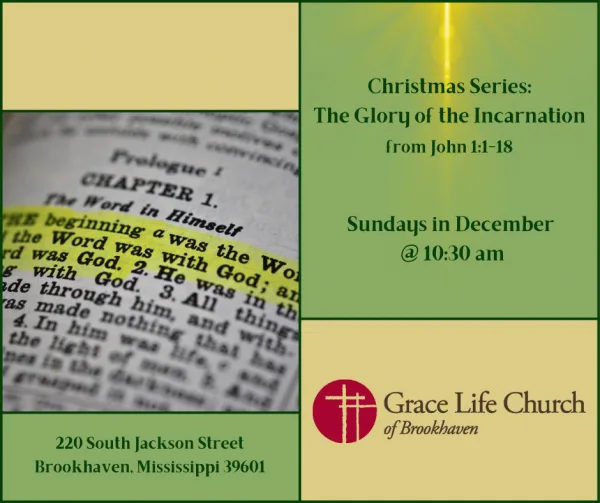
The Glory of the Incarnation

John 1
Sermon Study
John 1:14-18 reveals the glory of the incarnation as the eternal Word becomes flesh and makes God known. The sermon calls believers to let the truth of Christ's coming shape Christmas and all of life.
Primary Scripture
- John 1
Mentioned Scripture
- John 14
- Colossians 2
- Luke 1
- Exodus 20
- Romans 3
- Galatians 4
- Hebrews 10
- Ephesians 2
- Galatians 3
- Romans 4
Transcript
Well if you would please take your Bible and turn back to John chapter 1. We did read all of those verses earlier but this morning we'll be in verses 14 to 18 throughout the message. So you can have your Bible just turn there we'll get to those verses here in just a minute. Now in our first two messages in our series I told you how I have been getting ready for Christmas in my life and in our home. First and foremost I have really been doing what my wife needs me to do. Yes I have done what she needs me to do. She did ask me to go get a tree and I did that and this past week I cleaned up the yard.
We have we had our students over, our teenagers over for Christmas last Wednesday night and tried to get the yard as clean as I could this time of the year. But last week I shared that our family went to New Orleans last Friday night to see Sovereign Grace music. We had a great time as a family. In this afternoon our family is going to Jackson to do some shopping. I think we're gonna go out to eat and just enjoy some time together. Now I think most of you know this but family and even extended family is a big part of our lives and at Christmas we all get together at different times.
We went to Laurel this past Sunday afternoon to see my parents and my sister and my sister's family. My nephew was down from North Carolina with his family. We will go back to Laurel this Monday night to have Christmas with Christie's side of the family. Everybody will be there. It'll be large, it'll be loud, it'll be wild but it'll be good. And after Christmas we will go back to Laurel and we'll get together with my parents and my aunt on my mother's side. She is the last aunt on that side of the family. You may say, "Pastor, that's a lot of travel." It is. You may say, "Pastor, that is a lot of family time." It is.
And I promise none of us fight. But it is worth it. It really is worth it. Now this reminds me of a challenge I gave you back in our Thanksgiving messages. Look church, make sure that you make family the center of your holidays. Christmas, Thanksgiving, birthdays, all of those things that we do. Make family the center of your life. And some of you have not come from the best families. Well, you can start your own traditions and you could do things in a Christ-centered, in a very Christian way.
But as much as family is at the center of our Christmas, the most important thing for me to remember is the fact that Christmas is all about the birth of Christ. And if you have not been making strides to intentionally make sure that Christmas is all about Christ and the fact that God has provided us a Savior, well let's correct that. Let's correct that. Let's get that straight. Now for two weeks I have challenged you to read the Christmas accounts from Matthew's Gospel and Luke's Gospel. Now if I had to pick a favorite, I would pick Luke's account. I absolutely love Luke's account.
I love how Luke gives us so much about the birth of John the Baptist and how he tells us so much about Mary, the mother of Jesus, and how she reacted to being chosen by God to give birth to our Savior. And I have also been making this time of the year all about Jesus by taking us through John chapter 1 verses 1 to 18, which are some of the most important verses in all of the Bible. We have seen that verses 1 to 18 contain the deepest, the most profound, even the most difficult teaching to understand concerning the great glory of the Incarnation.
But on the other side, in verses 1 to 18, we have the clearest, the most thorough teaching concerning the Incarnation, and by faith and in faith and through faith and with the help of the Holy Spirit of God, we can get our minds around these things. Of course, there are great mysteries here that we can never fully get our minds around. And there are seeming contradictions that we can never fully explain or rectify, and we just accept those things by faith. But as God's people, we should not be intimidated by this teaching, and we should not run from these verses.
On the contrary, we should run to these things and understand that by faith and through study and with a lot of prayer and with the help of the Spirit in our lives, we can get our minds around these things. We can get these things in our minds and in our hearts, and when we do that, we will see and understand that we really can't get our minds around these things. And for me, it has been a blessing to hear how some of you have been grappling with this teaching. Some of you have been studying and reading and going back over these things like I have challenged you to do. But remember what the incarnation actually is.
This is a definition I have gone over a couple of times. The incarnation was and is the act of the eternal Son of God, whereby He took upon Himself a human nature and He became a man. And when He was a man, He was fully man in every way except sin, but at the very same time, He was fully God and He never ceased to be God. Now in our first message from verses 1 to 5, we studied what I called Jesus the divine Word. Listen to verse 1 in the Amplified.
It says, "In the beginning before all time was the Word Christ, and the Word was with God, and the Word was God Himself." And then last week from verses 6 to 13, we saw what I called man's response to the Word coming into the world. Listen to verse 11 and 12 in the Amplified. It says, "He came to that which is on, that which belonged to Him, His world, His creation, His possession, and those who were His own people, the Jewish nation.
They did not receive Him and welcome Him, but to as many as did receive and welcome Him, He gave the right, the authority, the privilege to become children of God, that is, to those who believe in and hereto trust in and rely on His name." Now this morning we're going to finish up these verses and what I'm calling the glory of the Incarnation, and that's the title of the series, "The Glory of the Incarnation." And out of these verses we will see five things. We're just going to follow the verses one at a time. We will see the nature of the Incarnation in verse 14. We will see the witness of the Incarnation in verse 15.
John goes back to John the Baptist here. We will see the experience of the Incarnation in verse 16, the power of the Incarnation in verse 17, and the visibility of the Incarnation in verse 18. So let's get started. Let's jump right into the message. Number one, I want us to see the nature of the Incarnation. That's in verse 14. The nature of the Incarnation. Now we know that verses 1 to 18 are the clearest, the most thorough teaching concerning the Incarnation, but out of these 18 verses there is one verse that encapsulates this entire teaching, and that is verse 14.
John says, "And the Word became blessed and dwelt among us, and we have seen his glory, glory as of the only Son from the Father, full of grace and truth." Now let's break down this verse and let's see what John is telling us as he is explaining the nature of the Incarnation. First John tells us the Word became flesh. Now before we get into this part of the verse, we have to remember that from verses 1 to 5 we saw that the Word is none other than Jesus, the promised Messiah. The Word is a person, not something that is written down or said. And notice what John says here in the King James.
The King James says the Word was made flesh, while the other translations say that he became flesh. And this word became, it's translated was made. This simply means to become or to come into existence. And this very same verb is found in verse 3 where John says, "All things came into being by him." So look at what John is saying here in verse 14. "It is not that Jesus was created." We know that Jesus was not created because he was and is and always will be the eternal God. John is saying that Jesus entered into a new form or a new being. He became a man. The eternal God was made into flesh.
Speaking of verse 3, the Bible scholar Vincent says, "All things became through him." And then speaking of verse 5 he says, "He in turn became flesh." But then second, John says that the Word came to us. Now all the translations use the word dwelt here. The Amplified says, "And lived among us." And this word dwelt here it means to abide. It means to tabernacle or to fix one's tabernacle. Some scholars say that this can mean to pitch a tent or to even live in a tent. So John is telling us that Jesus tabernacled in human flesh. He became a man and he lived in a tent of flesh among his own people, the Jews and the Jewish nation and other people.
And because of the written record of God's Word, we know that he lived over 30 years. He traveled hundreds of miles in his ministry, coming in contact with Jew and Gentile, rich and poor, sick and healthy, religious and even non-religious. Jesus interacted with Jewish leadership as well as the Roman leadership and he lived in a tent of flesh among mankind being fully man and fully God all at the same time. Simply the Word dwelt among them for over 30 years. Then third, John says that they saw his glory. Listen to what John says here.
Verse 14, "And the Word became flesh and dwelt among us and notice, and we have seen his glory, glory as of the only Son from the Father." Now question, who is this we? Who is this we? Who is John referencing? Well this is simple. This is John, those other disciples and many other believers. And notice the timing of when this was written. At this time John was the last living Apostle so he represented all who saw and heard him. He was the last living link to what Jesus did and said while on earth so that is why he said we, we have seen his glory. But we need to understand what they actually saw. This is important.
John and the others that he was including here, they did not see Jesus in the actual fullness of his glory. No, we can say it like this. They saw glimpses of his glory all throughout his life in ministry. They saw great and mighty glimpses of the glory of Jesus and all of the miracles that he performed. They saw a great glimpse of his glory at the transfiguration and you can see other examples when they saw glimpses of his glory. But they did not see the fullness of Christ in his glory. But if we fast forward to Revelation 1.17, we see that John at that time had a fuller revelation of Christ in his glory.
But then forth, John says that they saw the only begotten. Now the New American says the only begotten from the Father. The English Standard says the only son from the Father and this is important to understand. This does not speak of the origin of Jesus because he was not created. This speaks of Christ, the only one of his kind. He was and is the only son of God. That is why the English Standard says the only son from the Father. And then fifth, John says they saw his grace and truth. And here John is speaking of things that relate to salvation for men and man.
Grace speaks of the free gift of salvation which is not from a work or the will of man. And this truth speaks of Christ himself as the truth. Later on in John 14.6, Jesus said, "I am the way, the truth, and the life. No one comes to the Father except through me." So simply there is no salvation outside of the grace of God and there is no salvation outside of the truth of Christ Jesus. So here in verse 14, John reveals and he explains the very nature or the character of the Incarnation. He reveals what the Incarnation consisted of. I know it's wordy but listen to the amplified.
It says, "In the Word Christ became flesh and lived among us and we actually saw his glory. Glory as belongs to the one and only begotten son of the Father, the son who is truly unique, the only one of his kind, who is full of grace and truth, absolutely free of deception." John MacArthur sums up this verse by saying, and I'm quoting, "In the Incarnation God took on humanity. The infinite became the finite. Eternity entered in the time. The invisible became visible. The Creator entered his creation.
Simply God became a man." And Luke Church, if there is one verse and there is one portion of teaching that we take into our hearts and minds at this Christmas season, it's this verse. It's this verse. You might say, "Pastor, you just gave me permission to ignore everything else." No, I'm not telling you to do that. But if you do forget everything else, do not forget verse 14 and this teaching. Because this verse above all of the other verses sum up the teaching of verses 1 to 18 and the real meaning of Christmas. So I would challenge you to memorize it.
I don't know about you, but when I try to memorize and meditate on verses, I use little pieces of paper and post it notes at different places. I encourage you to memorize it, meditate on it. I encourage you parents, especially dads, to talk about this verse with your children and steal this into their minds and into their thinking. And one more thing, if you are a born-again believer, you have seen a great glimpse of the glory of God in and through your own salvation. Let me say that again. If you are a born-again believer, you have seen a great glimpse of the glory of God in and through your salvation. And share that, folks.
And if you have been a believer for many years, you have seen great glimpses of God's glory in and through others, in and through the work of the church. I'm thankful that as the pastor of Grace Like Brookhaven, I stand here and I have seen and I am seeing great glimpses of God's glory in your life, in your salvation, in your sanctification, how God is bringing us together to do the work of the church. I thought about it like this. Imagine sitting with John and listening to him retell all of the glimpses of God's glory that he saw.
Well, we are not John and I'm not going to even put us in the same category with John, but we have seen glimpses of his glory and we need to speak of those things, especially at Christmas. Then number two, in verse 15, we see the witness of the incarnation. Here in verse 15, we see the witness of the incarnation. Let's go back and look at verse 15. John says, "John bore witness about him and cried out, 'This was he of whom I said, 'He who comes after me ranks before me because he was before me.'" Now it has been a few days, but remember what we learned in verses 6 to 8. John was the first witness of many witnesses concerning Jesus.
He was not the only witness, but he certainly was the first and we could say one of the greatest witnesses of Christ Jesus and he still is today. But notice what the Apostle is telling us here about John. Two things. First, John says that John bore witness about Christ. The Apostle John says that John bore witness and he cried out. We see that language in the English Standard, the Legacy Standard, and the New American Standard.
And this means that his message was very bold and the gospel accounts tell us that he cried out in the wilderness and his message was so bold and so powerful that the impact of this message was felt all the way to Jerusalem and really all throughout the land of Israel and beyond. And the construction of the language here is in the present tense, which means his witness was ongoing and it was a continual witness. His witness was ongoing and continual and bold and very impactful and it still is today. Even though they took his life, his witness still is very much alive. But then second, John tells us that John was below Christ.
Look back at verse 15. This is important to see. John bore witness about him. That's Jesus and he cried out, "This was he of whom I said, 'He who comes after me ranks before me because he was before me.'" Now if you know the timeline of the birth of John and the birth of Jesus, you know that John was six months older than Jesus. But notice that John does not take that into account. John puts himself in a right relationship to Jesus by saying he said that Jesus was and is of higher rank and he refers to the pre-existence of Christ. So John clearly said that he was below Jesus. He clearly said that Jesus had a higher rank than he did.
So here in verse 15, John again mentions John the Baptist and his witness. He says that John was a very bold and a continual witness of Christ Jesus and he did this with great great humility seeing himself below Jesus. Again the Amplified says, "John testified repeatedly about him and has cried out testifying officially for the record with validity and relevance. This was he of whom I said, 'He who comes after me has a higher rank than I and has priority over me for he existed before me.'" Now a question, how does this apply to us at Christmas? Just as John was an ongoing continual witness for Christ and about Christ, we should be the same.
Our lives should be marked by the fact that we are a continual witness of Christ. Let me say that again. Our lives should be marked by the fact that we are a continual and bold witness for Christ verbally and this should be a bold witness and a continual witness. What good does it do to be a witness in your 20s and your 30s and maybe your 40s but yet by the time you reach your 60s and 70s you have ruined that witness. We must be a witness and a bold witness continuously.
And you might say, "Pastor Chris, that's not my personality." Well I say that this is not about personality but this is about the Spirit enabling us and empowering us to be a bold witness and the Spirit being a bold witness in and through us. And we start in our home, we start with our children and then we end with our children and we end with our home, we start with our family and we end with our family and then we move out into the world that we live in. As we are going we are to be a bold witness. So let's start this week. This is the most important week of the year.
Let's make sure that we are a bold and continual witness about Christ and for Christ. And then number three, John shows us the experience of the incarnation. In verse 16 we see the experience of the incarnation. Look at verse 16, "For from his fullness we have all received grace upon grace." Now to understand this experience and what John is saying, I want to ask four short questions. First, who is this we? We see it in the verse. He says, "For from his fullness we have all received." But who is this we? Now this is simple. John is speaking of himself, he is speaking of his fellow Apostles and those other first believers.
Really John is speaking of all who personally encountered Jesus savingly during the incarnation. Then second, what is this fullness? Now this word fullness here is found only once in John's gospel and it means that which is filled or has been filled. But we have to ask what this means here. Simply John is saying that the whole sum of God's grace and power appeared in this word Jesus who became a flesh. The New American commentary says, "The full resources of God stand behind the incarnate one." Let me say that again because it's so true.
The full resources of God stand behind and I would add to that by saying, "In the incarnate one." Now listen to what Paul says in Colossians 2.9. Paul says, "For in him," that's Christ Jesus, "all the fullness of deity," that's God, "dwells in bodily form." And get this, this fullness is what John and those believers who encounter Jesus witnessed for roughly three years. They witnessed and they experienced the fullness of God in the full resources of God in the flesh before them. Then third, what is this received? Look back at the verse.
"For from his fullness we have all received." Now remember, their faith was not just an intellectual faith. Their faith was not just an intellectual ascent. John refuted that kind of faith and that kind of approach to Jesus in salvation in verses 9 to 13 and he explained what it truly means to savingly receive him in those verses. But what did they receive? His fullness. His fullness. They did not receive part of Jesus. They did not receive just a portion of Jesus. They received Christ Jesus in his fullness, in his totality.
They did not receive Christ for what he could do for them but they received Christ for who he is, for who he was, and they received him in his very fullness. Question for you? When you came to faith in Christ by faith and in faith and through faith to the best of your ability and beyond your ability, did you receive Christ in his fullness or did you reach out to Christ for what he could do? Did you reach out for Christ to try to make your life a little better? Did you reach out to Christ just with this intellectual ascent?
You see true saving faith is when a lost sinner comes to the place whereby they are enabled by God, the Holy Spirit of God, where they reach out and they embrace Christ in his fullness, in his totality, no matter the consequences. That is only possible through the new birth. It is impossible in and of ourselves. But then fourth, the fourth question, what is this grace? Notice the verse says grace upon grace. This simply means they were witnesses of and they personally received and they experienced a limitless supply of grace. And we must see this.
John is saying that they personally experienced and received a limitless supply of the grace of God. The Amplified captures this well. It says, "And we have all received grace upon grace, spiritual blessing upon spiritual blessing, favor upon favor, and gift heaped upon gift." So here in verse 16, John gives the true and legitimate personal experience of and saving interaction with the incarnation of God. Do you see that? Grace upon grace, spiritual blessing upon spiritual blessing, favor upon favor, all from God.
Again, the Amplified, it says, "For out of his fullness, the super abundance of his grace and truth, we have all received grace upon grace, spiritual blessing upon spiritual blessing, favor upon favor, and gift heaped upon gift." And look, church, please make sure you get this. All of us must get this. This is to me the greatest example of experiential saving faith seen in the Bible. Let me repeat that. To me, this is the greatest example in teaching of the experiential saving faith that we must have.
Sure, John is setting himself up as a witness, as others as well, and we need to see his witness, but it is important for us to see that this is experiential. It wasn't just intellectual. John and all of these others that he includes here, they experienced grace upon grace, grace upon grace, favor upon favor, and that grace had a name. His name was Jesus. And look, church, intellectual faith and experiential faith are two different things, but only one will save. Only one is true and working and legitimate Christianity. The other is just cultural. That is why I love Luke 1.
And we see where the angel Gabriel comes to Mary to tell her that she had been chosen by God to give birth to the Messiah. In that young teenage girl, very young lady, what you see there is this true and experiential faith that wasn't head knowledge. She possessed and lived grace upon grace, favor upon favor, spiritual blessing upon spiritual blessing because she knew the God behind all of those things. And just like Mary's first Christmas was overflowing with grace upon grace, so should our Christmas. And then number four, out of verse 17, we see the power of the Incarnation. We see the power of the Incarnation. Let's read verse 17.
"For the law was given through Moses, grace and truth came through Christ Jesus." Now before we can get into the power of the Incarnation that we see here, we must establish and understand what is meant by the law. This consists of the Ten Commandments found at Exodus 20 and the Levitical Law, which would be over 600 laws of Moses that are found in Exodus, Leviticus and Deuteronomy. And in the Old Testament and under the Old Covenant, the Levitical Law was meant for the Jews, that would be the nation of Israel, and it was to reveal God's holy, pure and righteous character.
And it was meant to instruct the people of God how to live according to God's plan. But of course, the law that is seen as the Ten Commandments are moral in nature and they are meant for all men of all time. So now that we understand what this law was and is, let's look at the power of the Incarnation here. So first, we need to see the power and the powerlessness of the law. Let me explain that. The law was and is powerless. The law was and is powerless to save man.
Romans 3 20 says, "Because by the works of the law no flesh will be justified in his sight." Galatians 4 10 says, "For as many as are of the works of the law are under a curse, for it is written, cursed is everyone who does not abide by all things written in the book of the law to perform them." In Hebrews 10 4 says, "For it is impossible for the blood of bulls and goats to take away sins." But the law is powerful. The law was powerful to reveal man's sinful condition. Romans 3 20 says, "Because by the works of the law no flesh will be justified in his sight.
For through the law comes the knowledge of sin." And Hebrews 10 10 4 says, "For it is impossible for the blood of bulls and goats to take away sins." John MacArthur says, "It," that's the law, "merely convict sinners of their inability to keep perfectly God's righteous standards and condemns them to the eternal punishment of divine justice." So we see the powerlessness of the law and the power of the law. But then second, we need to see Christ and his grace and power. Simply and profoundly what the law could never do, that is to take away man's sin and to put him into a right relationship with God, Christ could do through grace and truth.
Notice, Christ came in grace and he came to give grace. Ephesians 2 8 9 says, "For by grace you been saved through faith and that not of yourselves it is the gift of God, the grace of God, not as a result of works that no one should boast." And then notice Christ came in power. Christ was able to do what the law could never do which was save men from the law.
Galatians 3 24 says, "Therefore the law has become a tutor to lead us to Christ that we may be justified by faith." John MacArthur says, "Again, it," the law, "It merely convict sinners of their inability to keep perfectly God's righteous standards and it condemns them to the eternal punishment of divine justice and thus reveals their need for the grace of forgiveness." And this is very important to understand. No man, no people can ever be made right with God by keeping the law. That needs to be repeated.
No man, no people can ever be made right with God by keeping the law and I will give us an Old Testament example one we may think was made right by keeping the law. Abraham. How was he made right with God? He did not have Christ. If we know our Bibles he lived long before Christ was born. So how in the world was Abraham made right with God? Well Romans 4 verses 1 to 3 says, "What then shall we say that Abraham our forefather according to the flesh was found? For if Abraham was justified by works he has something to boast about but not before God. For what does the scripture say?
And Abraham believed God and it was reckoned to him as righteousness." So here in verse 17 John gives us the power of the incarnation. For the law in keeping the law was powerless to make man right with God. Actually the only power found in the law is the power to condemn. But God grace and truth found in and from Christ Jesus has the power to make a man right with God and in a right standing before God. The Amplified says, "For the law was given through Moses but grace the unearned undeserved favor of God and truth came through Christ Jesus." And church this is what Christmas is all about. God came to us.
God came to us to save us from the curse of the law. Do you see? Let that sink in. God came to us to save us, all of us who were under the curse of the law. Galatians 3 13 says, "Christ redeemed us from the curse of the law by becoming a curse for us. For it is written cursed as everyone who hanged on a tree." That is what Christmas is all about. And then number five, John gives us the visible incarnation. The visible or seen incarnation. Look at verse 17. John says, "No one has ever seen God, the only God who is at the Father's side. He has made him known." Now what we have here is simple.
Here in verse 18 we have another way in which John describes the incarnation. And notice, John describes the incarnation in several ways all throughout verses 1 to 18. In verse 4 and 9 John presents Jesus as the light of men. That's a description of the incarnation. In verse 10 and 11 John tells us that he came to his old people the Jews, a description of the incarnation. In verse 14 John tells us that the Word became flesh. That's a description of the incarnation. And here in verse 18 John is still describing how Jesus was made known or made visible to men and men. First John says the Word has seen God.
Now many times Jesus equated himself with God and he placed himself with God. We've seen this. In verses 1 to 5 John shows us that Jesus, the divine Word, was with God from the beginning. Jesus was with God, came from God, and he is God. And in case anyone has any doubts about who Jesus was and is, John tells us that the Creator God made himself known as the life and the light of men. And here in verse 18 John simply says that no one has seen God. No one has seen God but the divine Word. Jesus has seen God. But then second John tells us the Word has a special relationship to God. Now notice how the New American Standard reads.
It says no one has seen God at any time. The only begotten God who is in the bosom of the Father, he has explained him. Notice John says that he is the only one or the begotten of God. The best translation from the original is the only begotten God. And remember we have learned that Jesus was not created but that he is the only one of his kind. And then notice John says he is with God. The English Standard says at his father's side the New American says that he was in the bosom of the Father. And notice this speaks of Christ and his intimate relationship with his father. But then third John says the Word has explained God.
The English Standard says he has made him known. The New American says he thus Jesus has explained him. That's God. And notice what we see here. The God who cannot be seen or known has been made known through Christ Jesus the Word who became flesh. And this Word explained in the New American this comes from the verb which means to interpret, to explain even in a methodological fashion. Then since in his Word study says this Word explained declares to relate in full to interpret or to translate. Simply put Jesus is the only full and true explanation of God the Father. All other explanations or interpretations of God outside of Jesus are false.
Some of you need to hear that. Jesus is the only full and true explanation of God the Father and all other explanations and interpretations of God outside of Jesus are false. So here in verse 18 John tells us that in Jesus the visible God was made visible. John tells us that Jesus actually and truly explained who God is in and through his life on earth. The Amplified says it very well. It's very wordy but listen it's very accurate. No one has seen God, his essence, his divine nature at any time. The one and only begotten of God that is the unique Son who is in the intimate presence of the Father.
He has explained him and interpreted and revealed the awesome wonder of the Father and look church if you want to know who God is look to Jesus. If you want to know what God says listen to Jesus. If you want to know how God reacts to people men and man look how Jesus reacted to men and men and look that's what Christmas is all about.
God the one true God he actually and truly revealed himself in and through his son Jesus to the world and we can know him and we can see him in his son as we find him in the scripture and we can experientially see him we can experientially know him as we walk with him and as we see Jesus in the scripture and this is possible with the Holy Spirit abiding in us filling us and enabling us in these things and look church that is what Christmas is all about God revealing himself to men and man through the God man Jesus his son. So these verses in this series it's all about the glory of the incarnation.
Now let's close out this message just like the first two. I challenge you to meditate on these verses. I challenge you to meditate on this teaching. Let's internalize these verses. Let's internalize this teaching so that we can meditate on these things. If it's not on the inside of us folks if it's not running around in our minds and in our hearts we can't meditate on these things. Let's all ask the Lord to help us and to enable us. Let's all ask the Lord to so move upon us here that when we see Christmas and Christmas related things like presents and lights and trees that we automatically think of the glory of the incarnation.
Let's all pray and ask God to so make an impression on our minds and on our hearts that we cannot help but recall these verses in this teaching when we even hear of Christmas and get this church. If this happens in us then the glory of the incarnation will be at the center of Christmas and really all of our lives.